


Bitcoin sits at $68,100 as of March 9, 2026. That number looks very different depending on who you ask. To one group, it’s a screaming buy. To another, it’s a dead cat bouncing above a trapdoor.
Key Takeaways
- BTC trades near $68K while S2F model projects $500K average this cycle
- $60K is the critical support – losing it could push BTC toward $50–55K
- Institutional ETF inflows returned in early March, snapping a 5-week outflow streak
- Analysts remain deeply split: some call $68K a screaming buy, others see a 2021-style crash ahead
Technical analyst Merlijn The Trader posted a side-by-side comparison over the weekend claiming Bitcoin’s current price structure mirrors the 2021 cycle top “exactly.” The thesis: lower highs, same sequence, and a final flush incoming before any meaningful recovery.
Under that read, $60,000 is the line. Hold it, and buyers stay in control. Lose it, and liquidity below – in the $50,000–$55,000 range – becomes the next destination.
BITCOIN IS MIRRORING THE 2021 TOP EXACTLY.
Same sequence. Lower highs. Same structure. 2021 ended with one final flush before the recovery.
$60K is the last line of defense.
Hold it: buyers take control.
Lose it: liquidity below becomes the target.2021 resolved violently.… pic.twitter.com/tqqgfF2gpv
— Merlijn The Trader (@MerlijnTrader) March 9, 2026
The 2021 precedent wasn’t clean or comfortable. That cycle resolved violently. The comparison isn’t flattering.
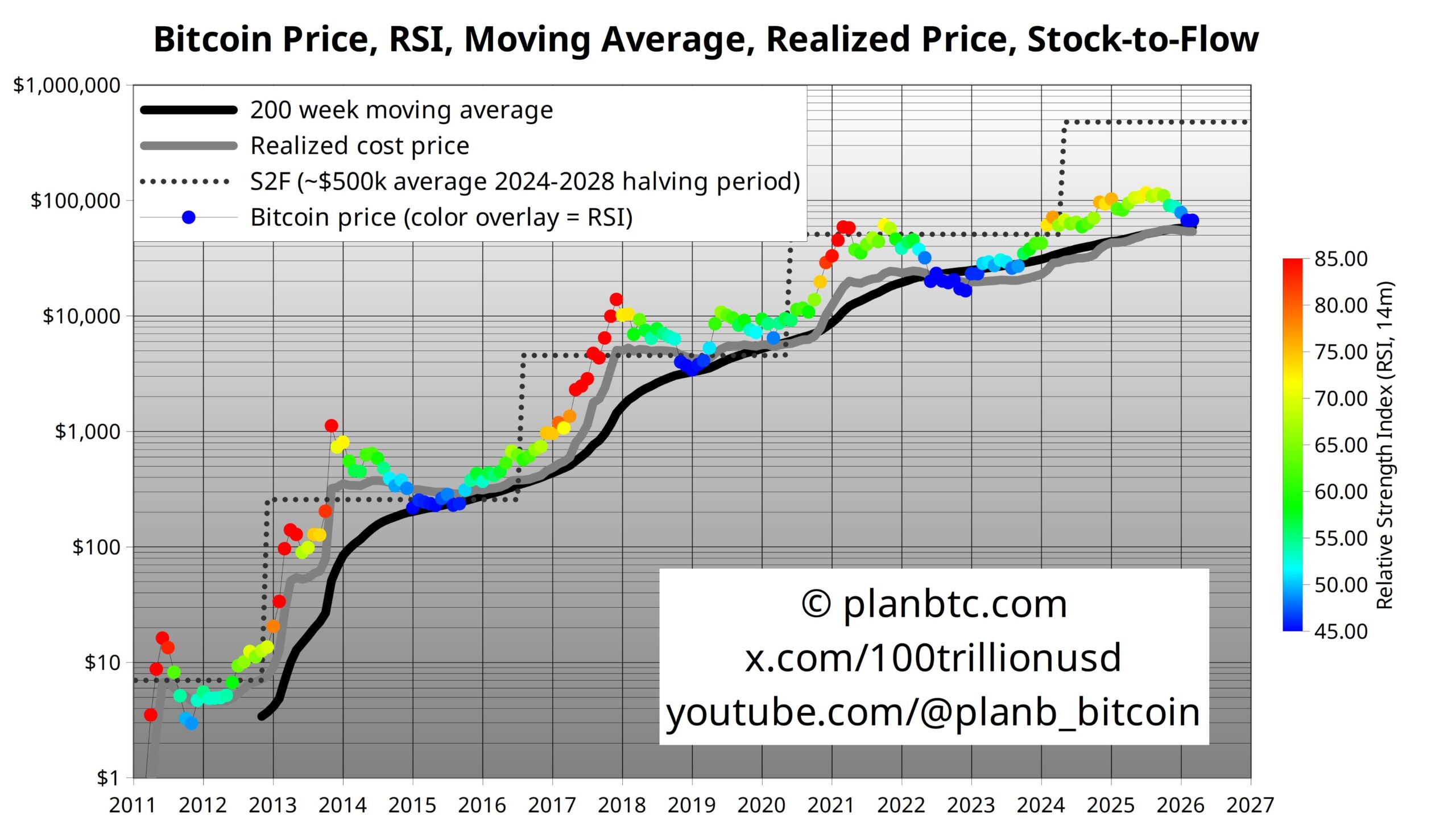
Meanwhile, PlanB’s Stock-to-Flow model tells a completely different story. His March 8 update projects an average Bitcoin price of $500,000 for the 2024–2028 halving cycle, with the RSI still sitting in cool territory – not yet showing the overheated readings that have historically marked cycle peaks.
By his framework, Bitcoin at $68K isn’t near a top. It’s still on the runway.
Institutional Inflows Return – But the Debate Isn’t Settled
After five consecutive weeks of outflows, crypto ETFs pulled in roughly $1 billion in the first week of March. That reversal matters. Grayscale and Bitwise have argued consistently that spot ETF approval has structurally altered Bitcoin’s demand profile – less boom-bust, more slow-burn accumulation, closer to how gold has traded over decades.
ZX Squared Capital isn’t buying it.
The firm is calling for a further 30% decline in 2026, citing the four-year cycle and ongoing geopolitical tension as catalysts for risk-off rotation. Gold is absorbing safe-haven flows. Bitcoin, for now, isn’t.
Peter Brandt has also flagged a worst-case scenario: an 80% drawdown from the cycle peak if parabolic advance structure breaks down entirely. The October 2025 high near $126,000 sets the reference point. Do the math.
The S2F Critics Are Getting Louder
PlanB’s model has faced renewed criticism heading into 2026. Detractors point to the 2020–2024 cycle, where S2F projected a $55,000 average but actual prices came in closer to $34,000 – a gap wide enough to raise serious questions about predictive reliability.
Vitalik Buterin has called the model “harmful,” arguing it produces false certainty in an asset class defined by demand shocks, macro regime changes, and structural evolution. The supply-scarcity framing tells you nothing about what happens when the Fed turns hawkish or geopolitical risk reprices every risk asset simultaneously.
The overfitting argument is harder to dismiss with each cycle that deviates from projections.
What to Watch
Three things will determine direction from here. Whether Bitcoin holds $60,000 on a daily closing basis – that’s the technical tripwire for the fractal crowd. The CLARITY Act’s progress through US legislature, which crypto markets are treating as a potential macro catalyst. And whether institutional inflows in March prove sustainable or were a one-week blip in a broader rotation toward gold.
The information provided in this article is for educational purposes only and does not constitute financial, investment, or trading advice. Coindoo.com does not endorse or recommend any specific investment strategy or cryptocurrency. Always conduct your own research and consult with a licensed financial advisor before making any investment decisions.


Kosta joined the team in 2021 and quickly established himself with his thirst for knowledge, incredible dedication, and analytical thinking. He not only covers a wide range of current topics, but also writes excellent reviews, PR articles, and educational materials. His articles are also quoted by other news agencies.