


Bitcoin responded well to Donald Trump’s signals that Iran has accepted most of a 15-point US peace framework, climbing back above $67,300 as the Strait of Hormuz reopened to oil tanker transit for the first time in weeks.
Key Takeaways
- BTC recovers above $67,300 after Trump Iran signals
- Trump: Iran “gave us most of the points,” deal “ahead of schedule”
- Iran allows 20–30 oil tankers through Strait of Hormuz as goodwill gesture
- Whale on-chain accumulation turns negative since mid-March
- Exchange Whale Ratio climbing toward historically elevated levels
The geopolitical signal moved the price. Whether the structure can hold it is a different question.
What the Chart Shows
On the one-hour chart from TradingView, Bitcoin spent March 27 and 28 grinding lower from $68,500 toward $65,800, finding a base in the early hours of March 28 before recovering steadily through March 29. The late Sunday session brought one more sharp dip to $65,900 before a strong recovery candle pushed price back to $67,585 before retracing to$67,400 at the time of writing.
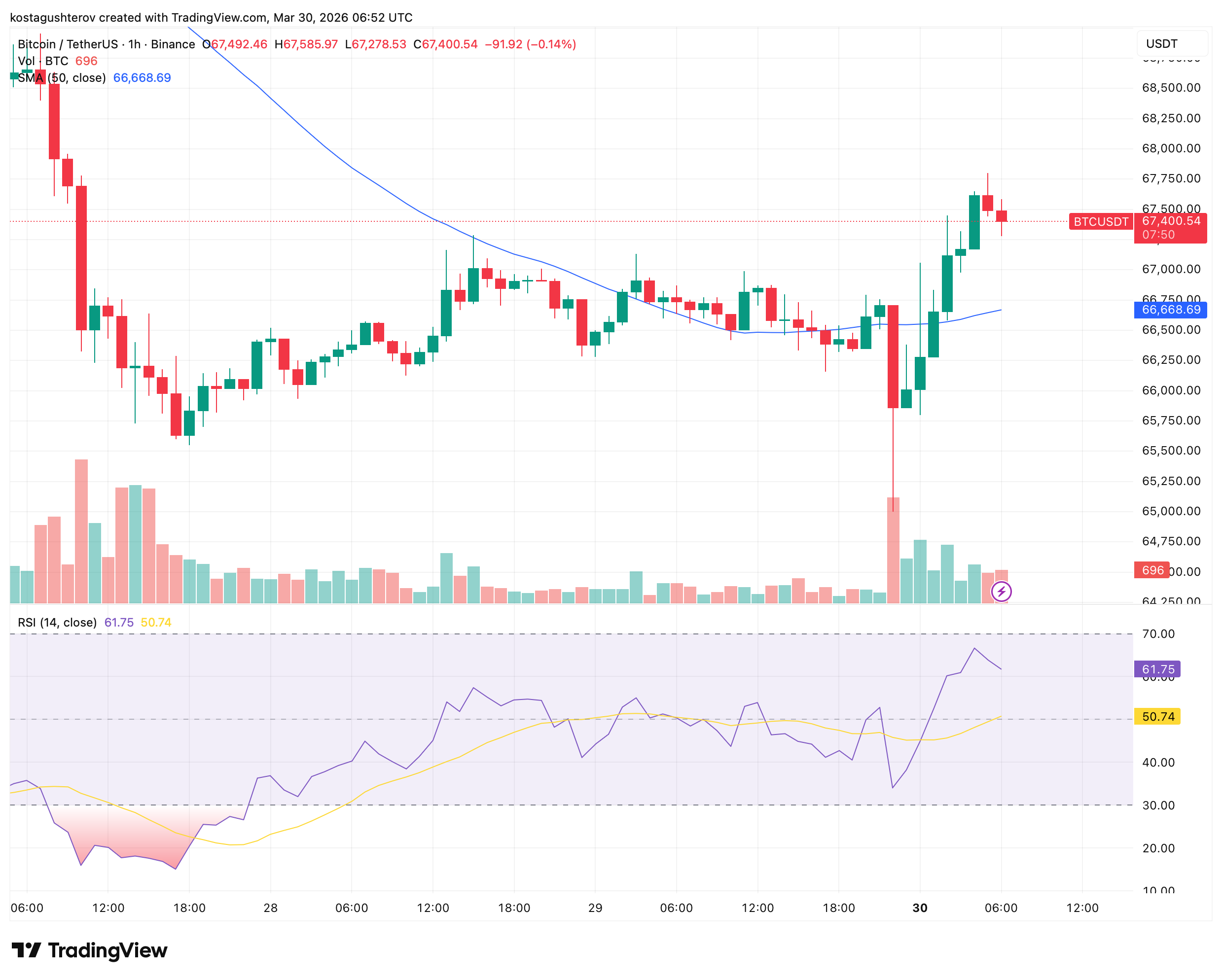
The 50-period simple moving average sits at $66,668 – below current price and sloping upward. For the first time in this chart window, the 50 SMA has moved from overhead resistance to rising support below price. The RSI reads 61.75 against a smoothed signal at 50.74. Buying conviction is running more than ten points above its average, the widest positive gap visible in the chart window, and building toward the upper half of the range without approaching overbought territory.
The specific news event that produced this shift came from Air Force One the previous evening.
What Trump Said and What Iran Said
According to CNN, Donald Trump stated that Tehran had accepted most of a proposed 15-point framework to end the ongoing war, describing negotiations as “ahead of schedule.” Trump cited Iran’s decision to allow 20 to 30 oil tankers to transit the Strait of Hormuz as evidence that Iran is serious about reaching a deal. A goodwill gesture. Not a reopening.
Iranian officials have not confirmed that characterisation. Foreign Minister Abbas Araghchi acknowledged that messages have been exchanged through intermediaries in Pakistan, a communication channel, not a policy concession. Iranian sources have described the US plan as “maximalist and unreasonable,” with demands that reportedly include Iran committing to no nuclear weapons, handing over highly enriched uranium, and ending support for regional proxy groups. The tanker transit happened as a gesture. The policy concessions behind it have not been confirmed.
What the market priced on March 30 was the possibility of de-escalation, not its confirmation.
What the On-Chain Data Shows
While the price was recovering on geopolitical optimism, three separate CryptoQuant metrics were describing a market that had already begun distributing rather than accumulating.
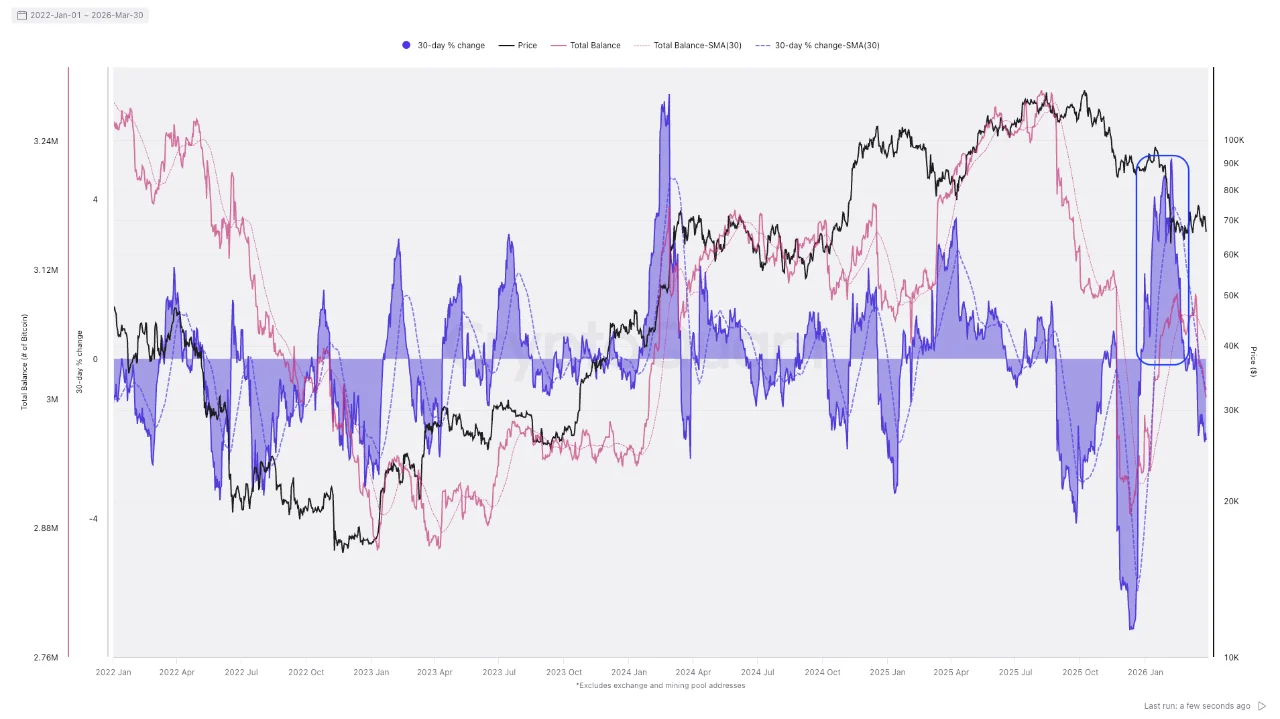
The Whale 30-day percentage change measures the net accumulation or distribution trend among large on-chain Bitcoin addresses. Through early 2026, the indicator showed aggressive accumulation that supported prices. As of mid-March it turned negative. Whale accumulation momentum has exhausted, with some large addresses shifting toward minor distribution.
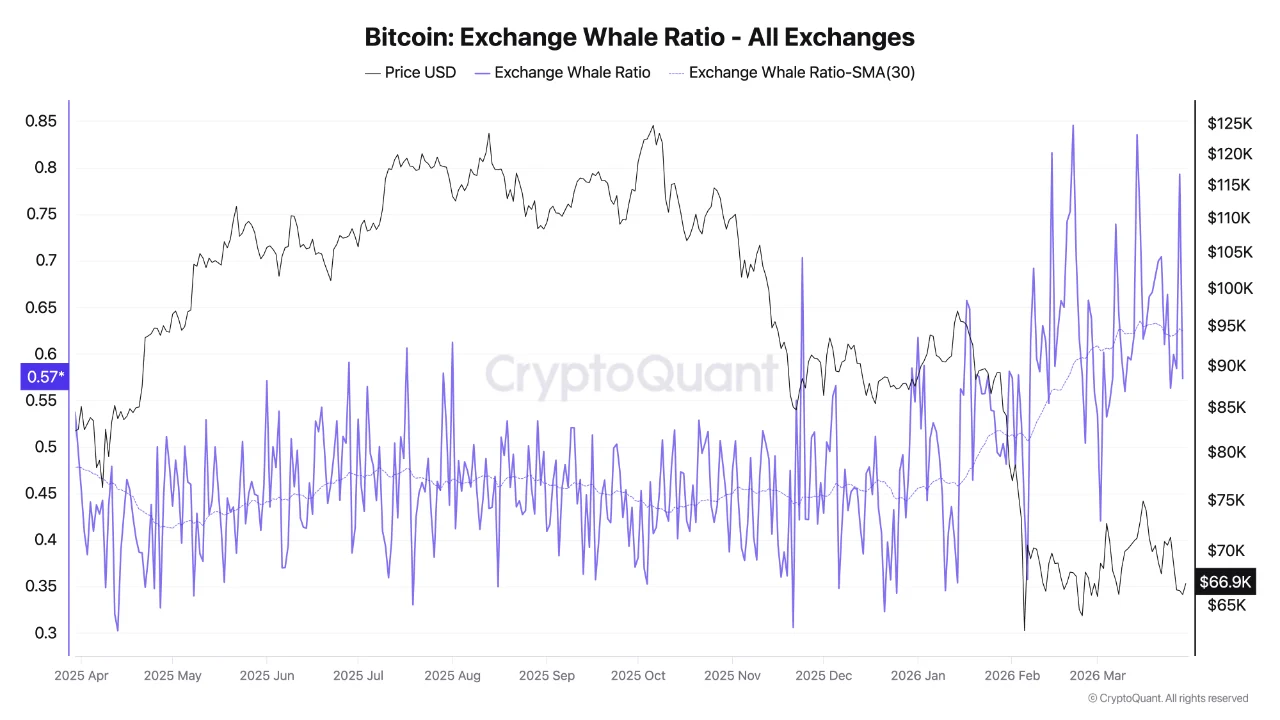
 The Exchange Whale Ratio measures the proportion of the top ten exchange inflows relative to total exchange inflows across all exchanges. When large holders are sending a growing share of all Bitcoin entering exchanges, it signals positioning to sell Bitcoin rather than hold. The 30-day SMA of this ratio has been climbing steadily since the start of 2026 and currently sits near 0.57, approaching a high near 0.6. Historically when this ratio reaches elevated levels, it has preceded increased volatility and selling pressure.
The Exchange Stablecoins Ratio sits at 1.51, a 24-month low. This metric measures stablecoin liquidity on exchanges relative to Bitcoin’s price. A high ratio signals abundant capital ready to buy. At 1.51, the stablecoin buffer that would absorb selling pressure and sustain a rally is significantly thinner than at any point in the past two years.
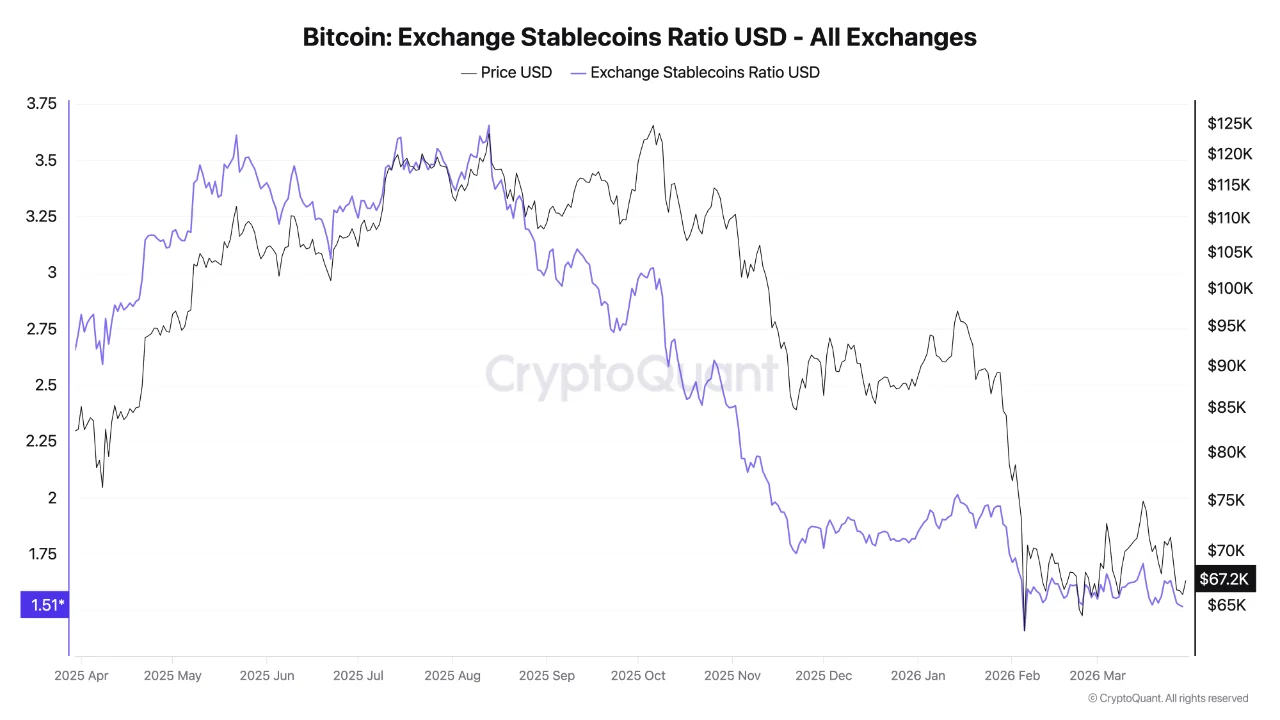
On-chain buying has ceased while large-scale inflows to exchanges are rising. Without fresh stablecoin liquidity entering the market, any attempt by large holders to realise gains from earlier accumulation relies entirely on the liquidity already present, making price sensitive to selling pressure if the geopolitical optimism fades.
The Tension the Data Leaves Open
The on-chain data and the geopolitical signal are not contradicting each other. They are describing different timeframes. Trump’s Iran signal removed the most immediate macro pressure that had been compressing Bitcoin for weeks, and the price reflected that removal in a single session. The CryptoQuant metrics are measuring what large holders were doing before that signal arrived, and what they were doing was distributing into existing liquidity, not accumulating into a recovery.
A market where whales are moving coins to exchanges and stablecoin dry powder is at a two-year low can rally on news. It struggles to sustain that rally without fresh capital following the news in. The next move in either direction will likely be determined not by what Trump says about Iran, but by whether institutional money responds to the geopolitical relief with actual inflows — or waits for the 15-point framework to become something more than messages exchanged through intermediaries in Pakistan.
The goodwill gesture opened a window. Whether anyone walks through it is what the next two weeks will answer.
The information provided in this article is for educational purposes only and does not constitute financial, investment, or trading advice. Coindoo.com does not endorse or recommend any specific investment strategy or cryptocurrency. Always conduct your own research and consult with a licensed financial advisor before making any investment decisions.

Kosta joined the team in 2021 and quickly established himself with his thirst for knowledge, incredible dedication, and analytical thinking. He not only covers a wide range of current topics, but also writes excellent reviews, PR articles, and educational materials. His articles are also quoted by other news agencies.