

In 48 hours, two of the most actively developed networks in crypto announced infrastructure milestones that would, in a different market environment, be moving price.
- Polygon’s Giugliano hardfork activates April 8.
- POL trades at $0.0904, below the 50 SMA at $0.0914.
- Solana Foundation launched STRIDE and SIRN on April 6.
- SOL trades at $80.07, sitting at the top of the critical $78–$82 support zone.
- U.S.-Iran tensions and elevated oil prices are making the Fed’s position significantly harder.
Building While the Market Looks Elsewhere
Polygon activates a core protocol upgrade tomorrow. Solana launched a proactive security framework two days ago, not as a strategic announcement but as a direct response to a $286 million exploit that exposed the limits of the ecosystem’s existing security model.
POL is at $0.0904. SOL is at $80. Both are below their 50 SMAs. Both are testing support levels that analysts are watching for signs of breakdown.
The gap between what is being built and what the market is pricing is the story this week. And both tokens are caught behind the same macro wall, one that is more complicated than a single Friday data release.
Polygon’s Giugliano: Infrastructure for a Competitive Fight
The Giugliano hardfork activates April 8 at 2PM UTC at block height 85,268,500. It is the most significant delivery so far in Polygon’s Gigagas roadmap, a scalability program targeting global payments and real-world asset settlement, the two use cases where the network is competing directly against Ethereum Layer-2 solutions and Solana.
Giugliano Upgrade
The Giugliano hardfork will be released on Polygon mainnet at block number 85,268,500, at approximately 2 PM UTC on April 8.
This upgrade: enables faster finality by letting producers announce blocks earlier, adds fee parameters directly in block headers,…
— Polygon Foundation (@0xPolygonFdn) April 6, 2026
According to information from Polygon, three changes define the upgrade. Block producers can now announce blocks earlier, cutting transaction confirmation times by approximately 2 seconds, validated on the Amoy testnet. Fee parameters are embedded directly into block headers using an EIP-1559 structure, giving developers and dApps native access to gas pricing without external estimation services. New RPC endpoints allow wallets to query fee data independently, removing an infrastructure dependency that has created friction for developers building on the network.
Node operators must update to Bor v2.7.0 or Erigon v3.5.0 before activation. Regular users and token holders are not required to act.
Faster finality and cleaner fee infrastructure address the two friction points that have historically pushed high-frequency DeFi developers toward competing chains. The upgrade is a direct competitive response to that pressure. The market has not acknowledged it, POL has been in a consistent downtrend since early March, falling from $0.102 to $0.0904, with RSI at 32.63 approaching oversold and the 50 SMA sitting above price as resistance.
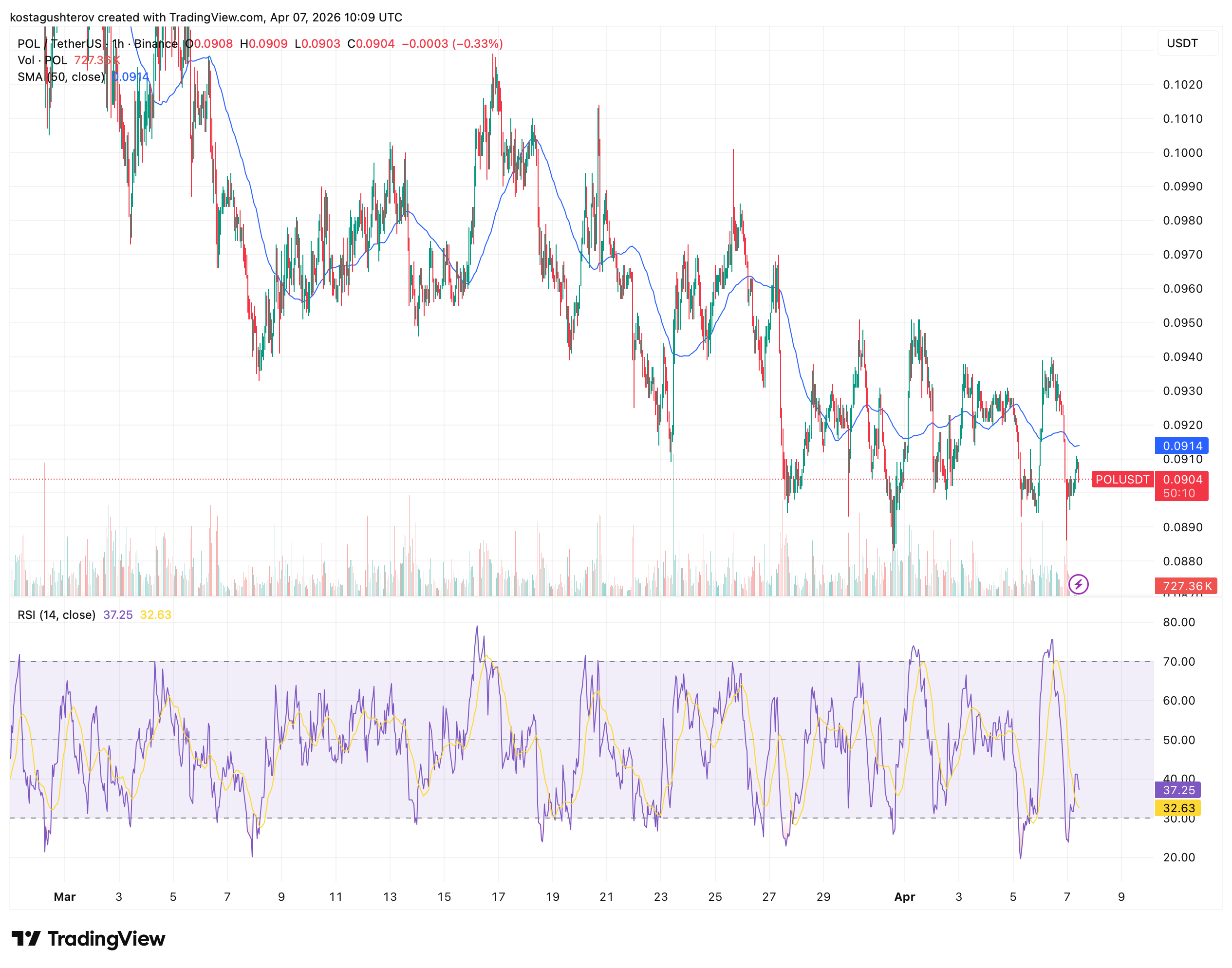
The upgrade activates tomorrow into a chart that shows no anticipation of it. That indifference is not a judgment on the upgrade’s quality. It reflects where trader attention currently sits, and Solana’s situation this week makes the same point from a different angle.
Solana: Security Infrastructure Built From a $280 Million Lesson
The Solana Foundation’s April 6 launch of STRIDE and SIRN was not a scheduled roadmap delivery. It was a direct institutional response to the $280 million Drift Protocol exploit, an attack attributed to social engineering rather than a code vulnerability, which meant it was not catchable by the conventional audit processes the ecosystem had been relying on. The foundation’s response was to change the model entirely.
STRIDE, the Solana Trust, Resilience and Infrastructure for DeFi Enterprises framework, assesses protocols across eight domains including smart contract integrity and governance. Its support is tiered by scale: protocols with $10 million or more in total value locked receive free 24/7 active threat monitoring. Those with $100 million or more receive foundation-funded formal verification, a mathematical approach to proving code correctness rather than testing for known attack vectors. Results are published in a public repository, giving users and investors a transparent risk assessment tool that did not previously exist at the ecosystem level.
SIRN operates alongside it as a real-time crisis coalition. Its members, Asymmetric Research, OtterSec, and Neodyme, share threat intelligence continuously, designed to contain active exploits before they reach their full damage potential. Together the two initiatives shift Solana’s security posture from reactive to continuous, a structural change that matters significantly more to institutional capital evaluating DeFi exposure than to retail traders watching hourly price charts.
SOL’s price reflects the latter group’s priorities right now. At $80.07, it sits just below the 50 SMA at $80.84 at the upper edge of the $78–$82 support zone analysts identify as the current floor.
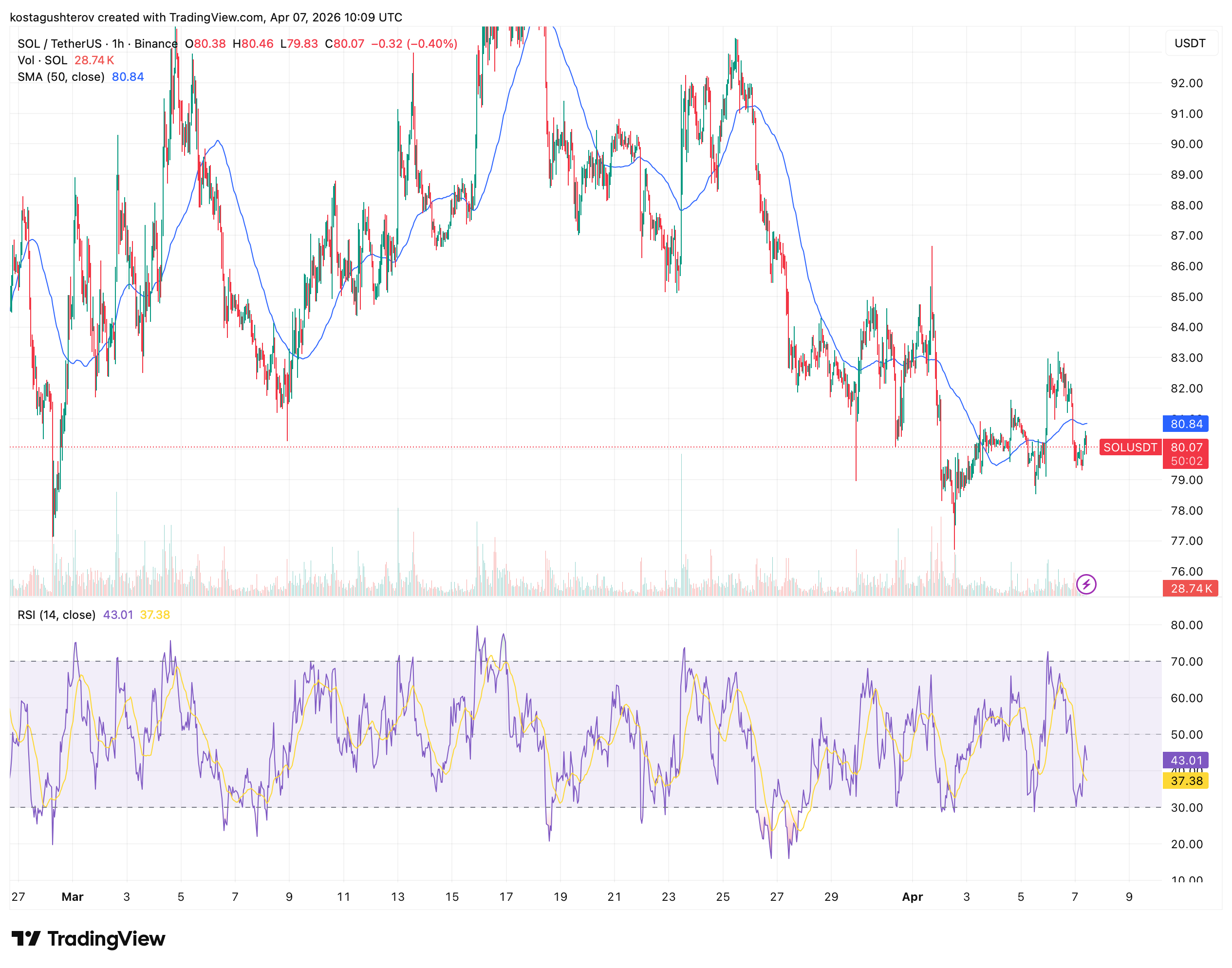
A head-and-shoulders pattern on the chart points toward $73 as the next meaningful level if that support breaks. RSI at 43.01 is not yet oversold, there is technical room for further decline before momentum indicators reach extreme levels.
The security launch is a long-term fundamental positive. The chart is reading a shorter-term reality, one shaped by the same external conditions pressing on Polygon.
The Same Macro Wall and Why It’s More Than Friday’s CPI
Both networks are doing what serious infrastructure projects do during downturns, building the capabilities that justify long-term value rather than waiting for price recovery to fund development. The market is not pricing either for it, and the reason runs deeper than a single data release.
Friday’s CPI is the most visible variable. But the conditions feeding into it are not purely domestic. U.S.-Iran tensions remain unresolved, no ceasefire framework has been confirmed, and the situation around the Strait of Hormuz continues to keep oil prices elevated. Energy costs feed directly into inflation readings. Persistent oil price pressure is making it significantly harder for the Federal Reserve to justify a move toward rate cuts, not because the economy is necessarily strong, but because easing into elevated energy prices risks accelerating the inflation the Fed has spent two years trying to contain.
That is the structural problem beneath Friday’s number. A central bank that cannot ease without reigniting inflation is one that keeps the pressure on risk assets indefinitely, not just through one CPI print but through the entire rate environment that follows it. Crypto markets have been pricing that constraint since late March. POL and SOL are both expressions of it.
A soft CPI print on Friday would reduce near-term pressure and give the market room to begin pricing in fundamental developments like Giugliano and STRIDE. It would not resolve the tension between geopolitical risk, oil prices, and Fed optionality that has been the dominant force on risk assets for weeks. A hot print, particularly one where energy costs are a visible driver, would reinforce the Fed’s position, remove any near-term case for rate relief, and extend the period where macro conditions override everything else regardless of what networks are building.
POL approaching oversold at $0.0904 and SOL sitting on critical support at $80 are the same situation expressed in two charts. Friday’s data is the next signal. The Iran situation is the variable that could move markets before Friday even arrives.
The Bigger Picture
The most consequential crypto infrastructure work consistently happens during downturns. Teams build when price is not a distraction, and the networks that emerge from macro compression with stronger technical foundations and better security are the ones that lead the next cycle rather than follow it.
Polygon and Solana are both in that process right now. Giugliano positions POL for the real-world asset settlement market that institutional adoption will eventually require. STRIDE and SIRN position Solana’s DeFi ecosystem for the institutional scrutiny that large-scale protocols will face as the space matures. Neither development is visible in this week’s price action, but both will be visible in the competitive landscape when macro conditions eventually shift.
That shift depends on variables neither network controls: an inflation reading, a diplomatic outcome, and a central bank decision that will be shaped by both. The infrastructure being built this week will outlast all three.
The information provided in this article is for educational purposes only and does not constitute financial, investment, or trading advice. Coindoo.com does not endorse or recommend any specific investment strategy or cryptocurrency. Always conduct your own research and consult with a licensed financial advisor before making any investment decisions.

Kosta joined the team in 2021 and quickly established himself with his thirst for knowledge, incredible dedication, and analytical thinking. He not only covers a wide range of current topics, but also writes excellent reviews, PR articles, and educational materials. His articles are also quoted by other news agencies.