

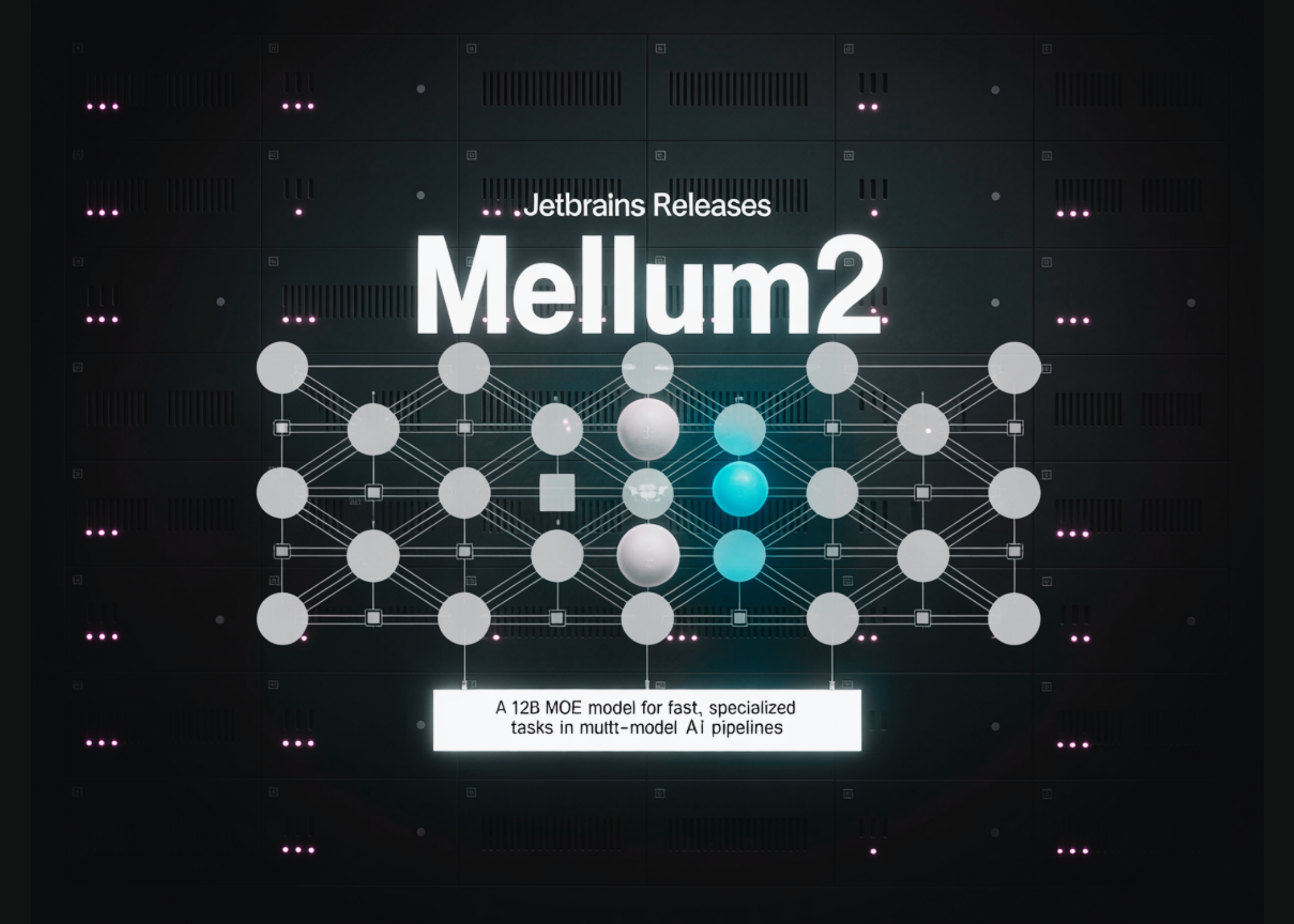
JetBrains released Mellum2, open-sourcing the weights under the Apache 2.0 license. The first version of Mellum was a completion-focused 4B dense model. Mellum2 is its successor: a general-purpose model specialized in software engineering. It covers code generation and editing, debugging, multi-step reasoning, tool use and function calling, agentic coding, and conversational programming assistance.
JetBrains team positions Mellum2 as a “focal model” — a fast, specialized component inside larger AI systems, not a standalone replacement for frontier models.
Architecture
Mellum2 uses a Mixture-of-Experts (MoE) architecture with 12B total parameters and 2.5B active parameters per token. In MoE models, only a subset of parameters runs on each token. Here, the model has 64 experts and activates 8 per token. This keeps per-token compute equivalent to a 2.5B dense model, while the total parameter count provides higher capacity for specialization.
Key architectural details:
- Layers: 28
- Hidden size: 2304
- MoE experts: 64 total, 8 activated per token
- Attention: Grouped-Query Attention (GQA) with 32 query heads and 4 KV heads
- Sliding Window Attention (SWA): Applied to three of every four layers, with a window size of 1,024. Full attention runs on the remaining layer.
- Context length: 131,072 tokens
- Multi-Token Prediction (MTP) head: Serves as an auxiliary pre-training objective and as a built-in draft model for speculative decoding
- Precision: bfloat16
- Vocabulary size: 98,304
The model handles natural language and code. It is not multimodal — there is no image or video input.
Pre-Training
Pre-training spans approximately 10.6 trillion tokens through a three-phase curriculum. The data mixture progressively shifts from diverse web content toward curated code and mathematical content across the three phases.
Training used the Muon optimizer under FP8 hybrid precision with a Warmup-Hold-Decay learning rate schedule with linear decay to zero.
After pre-training, the base model’s context window was extended to 128K tokens using a layer-selective YaRN method before post-training began.
The Model Family
JetBrains team released six checkpoints covering the full training pipeline:
| Checkpoint | Description |
|---|---|
| Mellum2-12B-A2.5B-Base-Pretrain | Base checkpoint before long-context extension |
| Mellum2-12B-A2.5B-Base | Final base model after context extension |
| Mellum2-12B-A2.5B-Instruct-SFT | Supervised fine-tuned instruction checkpoint |
| Mellum2-12B-A2.5B-Thinking-SFT | Supervised thinking checkpoint |
| Mellum2-12B-A2.5B-Instruct | RL-tuned instruction model |
| Mellum2-12B-A2.5B-Thinking | RL-tuned thinking model |
Post-training follows two stages: supervised fine-tuning (SFT), then reinforcement learning with verifiable rewards (RLVR) on math, executable coding, tool use, instruction following, reasoning, and knowledge tasks.
The Instruct variant answers directly, without an externalized chain of thought. Use it for low-latency tasks: direct answers, tool use, and instruction following.
The Thinking variant emits an explicit reasoning trace before its final answer. Use it for complex debugging, multi-step planning, or agentic flows where step-by-step reasoning matters.
Benchmark Results
All numbers below are self-reported by JetBrains. The comparison set is open-weight models in the 4B–14B range.
Coding:
| Benchmark | Mellum2 Instruct | Qwen3.5 (4B) | Qwen3.5 (9B) | Ministral 3 (14B) | OLMo-3 (7B) | Seed-Coder (8B) |
|---|---|---|---|---|---|---|
| LiveCodeBench v6 | 37.2 | 51.0 | 63.7 | 42.4 | 28.2 | 28.1 |
| EvalPlus | 78.4 | 69.4 | 71.8 | 74.1 | 67.3 | 73.8 |
| MultiPL-E | 67.1 | 51.0 | 67.1 | 71.5 | 36.1 | 77.0 |
Tool Use:
| Benchmark | Mellum2 Instruct | Qwen3.5 (4B) | Qwen3.5 (9B) | Ministral 3 (14B) | OLMo-3 (7B) |
|---|---|---|---|---|---|
| BFCL v3 | 66.3 | 64.1 | 70.5 | 52.7 | 41.9 |
| BFCL v4 | 44.2 | 52.0 | 60.6 | 38.8 | 19.8 |
Math:
| Benchmark | Mellum2 Instruct | Qwen3.5 (4B) | Qwen3.5 (9B) | Ministral 3 (14B) | OLMo-3 (7B) |
|---|---|---|---|---|---|
| AIME 2025+2026 | 41.7 | 38.3 | 58.3 | 33.3 | 40.0 |
| GSM-Plus | 80.5 | 85.2 | 87.9 | 86.6 | 85.8 |
Knowledge and Conversational:
| Benchmark | Mellum2 Instruct | Qwen3.5 (4B) | Qwen3.5 (9B) | Ministral 3 (14B) | OLMo-3 (7B) |
|---|---|---|---|---|---|
| MMLU-Redux | 78.1 | 87.5 | 91.1 | 85.9 | 71.8 |
| GPQA Diamond | 40.9 | 76.8 | 79.8 | 58.6 | 40.9 |
| IFEval | 75.8 | 82.1 | 83.9 | 67.3 | 83.2 |
| MixEval | 62.2 | 65.9 | 71.1 | 71.2 | 59.4 |
Benchmark notes:
- EvalPlus is the mean of HumanEval+ and MBPP+
- AIME is the mean of AIME 2025 and AIME 2026 (30 questions each)
- BFCL v4 is the macro-average of five subtasks: v1, v2, v3, web search, memory
- Seed-Coder (8B) does not support native tool calling; BFCL scores are not listed for it

Use Cases
JetBrains identifies four production scenarios where Mellum2’s latency and efficiency profile is relevant:
- Routing and orchestration: In a multi-model system, a router analyzes incoming prompts and selects the appropriate model or tool for each task. Mellum2’s low per-token compute makes it suitable for this high-frequency classification step.
- Low-latency RAG pipelines: Retrieval-Augmented Generation (RAG) systems retrieve relevant context, summarize it, and generate a response. Mellum2 handles retrieval summarization at lower latency than larger dense models.
- Sub-agents in complex workflows: Agent pipelines break tasks into steps: context gathering, planning, validation, and execution. Mellum2 can handle repetitive or latency-sensitive steps instead of routing every step through a single large frontier model.
- Private and local deployment: The Apache 2.0 license permits self-hosting without restrictions. Engineers can run Mellum2 on their own infrastructure, keeping code and data under their control.
Strengths and Limitations
Strengths:
- MoE design activates only 2.5B of 12B parameters per token — per-token compute equivalent to a 2.5B dense model
- MTP head enables speculative decoding without a separate draft model
- 131,072 token context window
- Full checkpoint set released: base pretrain, base, SFT, and RL-tuned variants for both Instruct and Thinking
- Apache 2.0 license — permits commercial use, self-hosting, and fine-tuning
- Strong EvalPlus (78.4) and BFCL v3 (66.3) scores relative to 4B–14B comparisons
- vLLM support, including optional tool-calling via
--tool-call-parser hermes
Limitations:
- Text and code only — no image or multimodal input
- LiveCodeBench v6 (37.2) trails Qwen3.5 9B (63.7) and Ministral 3 14B (42.4)
- GPQA Diamond (40.9) and MMLU-Redux (78.1) are below most models in the comparison set
- GSM-Plus (80.5) is below all comparable models listed
- Not designed for frontier-level tasks — JetBrains explicitly positions Mellum2 as a component model
Marktechpost’s Visual Explainer
Getting Started
Serve Mellum2 with vLLM:
pip install vllm
vllm serve JetBrains/Mellum2-12B-A2.5B-Instruct --max-model-len 131072
With tool calling enabled:
vllm serve JetBrains/Mellum2-12B-A2.5B-Instruct \
  --max-model-len 131072 \
  --enable-auto-tool-choice \
  --tool-call-parser hermes
Using the Hugging Face Transformers library:
from transformers import AutoTokenizer, AutoModelForCausalLM

tokenizer = AutoTokenizer.from_pretrained("JetBrains/Mellum2-12B-A2.5B-Instruct")
model = AutoModelForCausalLM.from_pretrained("JetBrains/Mellum2-12B-A2.5B-Instruct")

messages = [{"role": "user", "content": "Write a Python function to reverse a string."}]
inputs = tokenizer.apply_chat_template(
    messages,
    add_generation_prompt=True,
    tokenize=True,
    return_dict=True,
    return_tensors="pt",
).to(model.device)

outputs = model.generate(**inputs, max_new_tokens=512)
print(tokenizer.decode(outputs[0][inputs["input_ids"].shape[-1]:]))
Check out the Model Weights and Technical details. Also, feel free to follow us on Twitter and don’t forget to join our 150k+ ML SubReddit and Subscribe to our Newsletter. Wait! are you on telegram? now you can join us on telegram as well.
Need to partner with us for promoting your GitHub Repo OR Hugging Face Page OR Product Release OR Webinar etc.? Connect with us