


Speech-only spoken language models (SLMs) lag behind text and text-speech models in performance, with recent discrete autoregressive (AR) SLMs indicating significant computational and data demands to match text models. Since discretizing continuous speech for AR creates bottlenecks, we explore whether continuous diffusion (CD) SLM is more viable. To quantify the SLMs linguistic quality, we introduce the phoneme Jensen-Shannon divergence (pJSD) metric. Our analysis reveals CD SLMs, mirroring AR behavior, exhibit scaling laws for validation loss and pJSD, and show optimal token-to-parameter ratios decreasing as compute scales. However, for the latter, loss becomes insensitive to choice of data and model sizes, showing potential for fast inference. Scaling CD SLMs to 16B parameters with tens of millions of hours of conversational data enables generation of emotive, prosodic, multi-speaker, multilingual speech, though achieving long-form coherence remains a significant challenge.
- ‡ Core contributor
- § Core advising
- ** Work done while at Apple
Figure 1: Scaling law fit for validation loss. Training (•) and testing (×) points are shown alongside compute-optimal points (★).
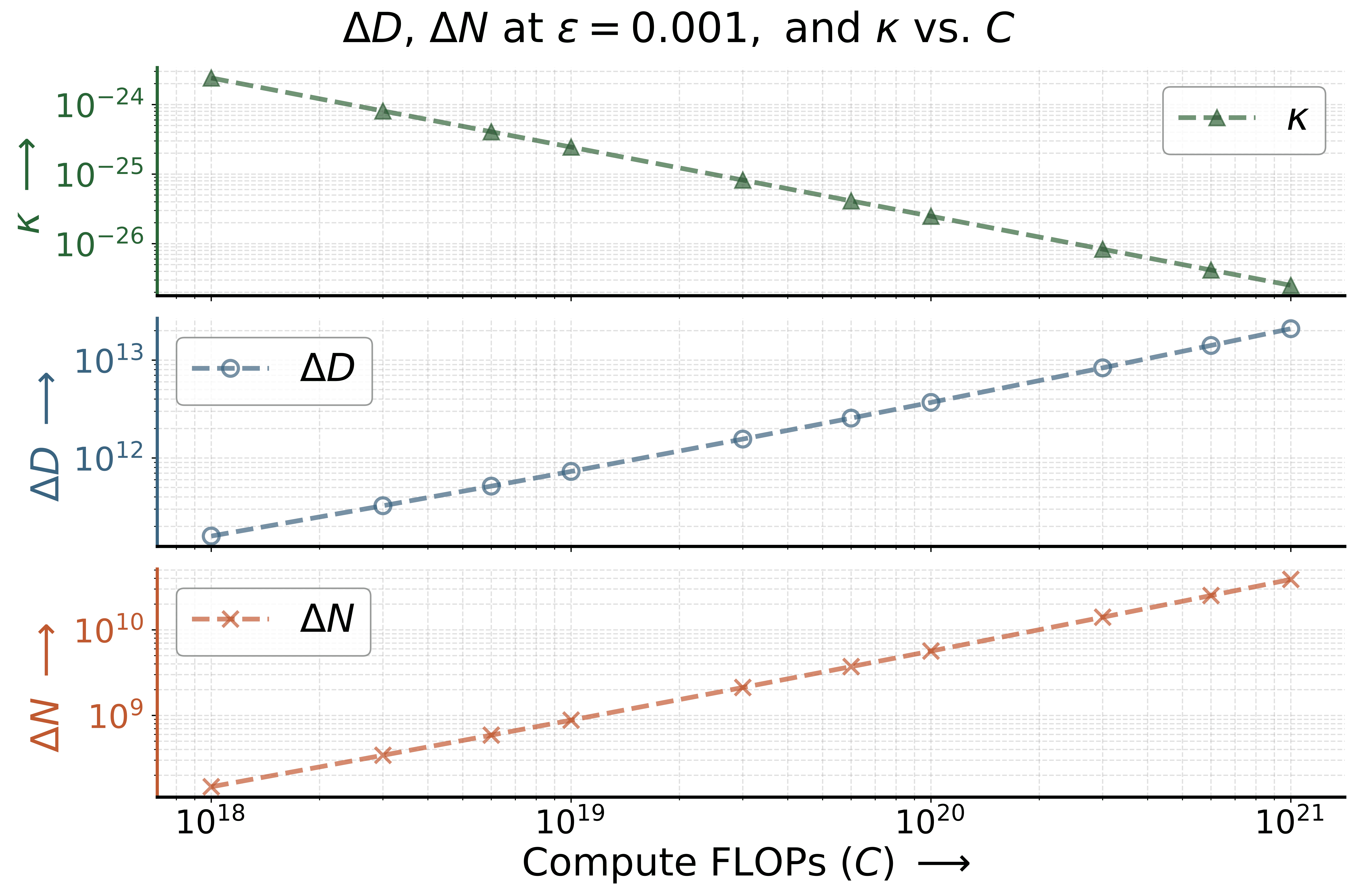
Figure 2: The curvature κ of isoFLOPs at their optima decreases as compute increases: flattening corresponds to approximately two orders of magnitude expansion in the range of model (ΔN) and dataset (ΔD) sizes yielding a loss within ε of the optimum L*. Thus, higher compute allows near-optimal performance across a much wider variety of parameter-to-data allocations, opening up an efficient inference frontier.