


BitMine’s push to turn one of the world’s largest corporate Ethereum holdings into a source of recurring income generated nearly $46 million from staking last quarter.
Yet a $92.1 million options loss overwhelmed those gains, while rising treasury costs and aggressive share issuance further weakened the economics for existing shareholders.
For the fiscal third quarter ended May 31, the firm reported that revenue surged to $46.5 million from $2.1 million in the same period a year earlier. Approximately 98%, or $45.7 million, came from staking and validation as BitMine accelerated its shift away from Bitcoin mining and toward an Ethereum-focused treasury model.
Despite that growth, the company posted an $83.6 million net loss, compared with a $623,000 deficit during the comparable quarter last year.
Options losses erase BitMine’s early Ethereum staking gains
The largest immediate drag on BitMine’s quarterly performance was the company’s options strategy.
BitMine recorded a $92.1 million loss on Ethereum-linked derivatives during the quarter, roughly twice the revenue generated by its staking operation over the same three months.
The company attributed $78.6 million of the loss to the net impact of option contracts that expired during the period, while another $14 million was attributable to exercised positions. A $534,000 gain on contracts that remained open provided only a small offset.
BitMine had no derivatives activity during the comparable quarter last year, marking a sharp change in the risk profile of its treasury operations.
Over the first nine months of the fiscal year, derivative losses totaled $133.3 million. That included $79.3 million in losses from exercised contracts and $54.5 million from expired positions, partly offset by a $515,000 gain on open contracts.
Over the same period, BitMine generated $56.9 million from staking and validation. The derivatives losses were therefore more than twice the income produced by staking ETH to help validate transactions on the Ethereum network.
BitMine said its strategy consisted primarily of selling put options as part of its broader treasury-management program.
Such contracts can generate premium income or facilitate asset purchases, but they can also create significant losses when market prices move against the seller, or contracts are settled under unfavorable conditions.
The scale of BitMine’s losses suggests that its attempt to generate additional returns from options has so far offset the income from its validation infrastructure.
Meanwhile, the firm’s general and administrative expenses also climbed to $37.3 million from $744,000 a year earlier. Management attributed the increase largely to digital-asset custody and treasury-management fees, higher salaries, and increased cash and stock-based compensation for directors.
Staking revenue still covered the company’s quarterly cost of sales and administrative expenses before digital-asset valuation changes. Even after excluding several noncash items, BitMine’s own non-GAAP calculation showed an adjusted net loss of about $70.8 million.
That distinction is central to the filing. The validation business has begun generating meaningful recurring revenue, but the broader treasury strategy has consumed those gains.
BMNR equity sales turn treasury growth into shareholder dilution
BitMine’s rapid accumulation of Ethereum was financed primarily through public equity markets, placing most of the funding burden on common shareholders.
During the nine months ended May 31, the company sold approximately 340.7 million BMNR shares through its at-the-market program, raising $11.87 billion after issuance costs. Over the same period, BitMine spent about $11.69 billion purchasing ETH.
The resulting dilution was substantial. Outstanding common shares increased by 149% over nine months, from 232.4 million on Aug. 31, 2025, to 579.7 million at the end of May, 2026. The share count continued to climb after the quarter, reaching 603.2 million by July 9.
As of May 31, this equity-funded expansion allowed BitMine to accumulate 5.42 million ETH with a cumulative cost basis of $19.05 billion. The company’s ETH holdings have expanded to 5.7 million ETH as of press time.
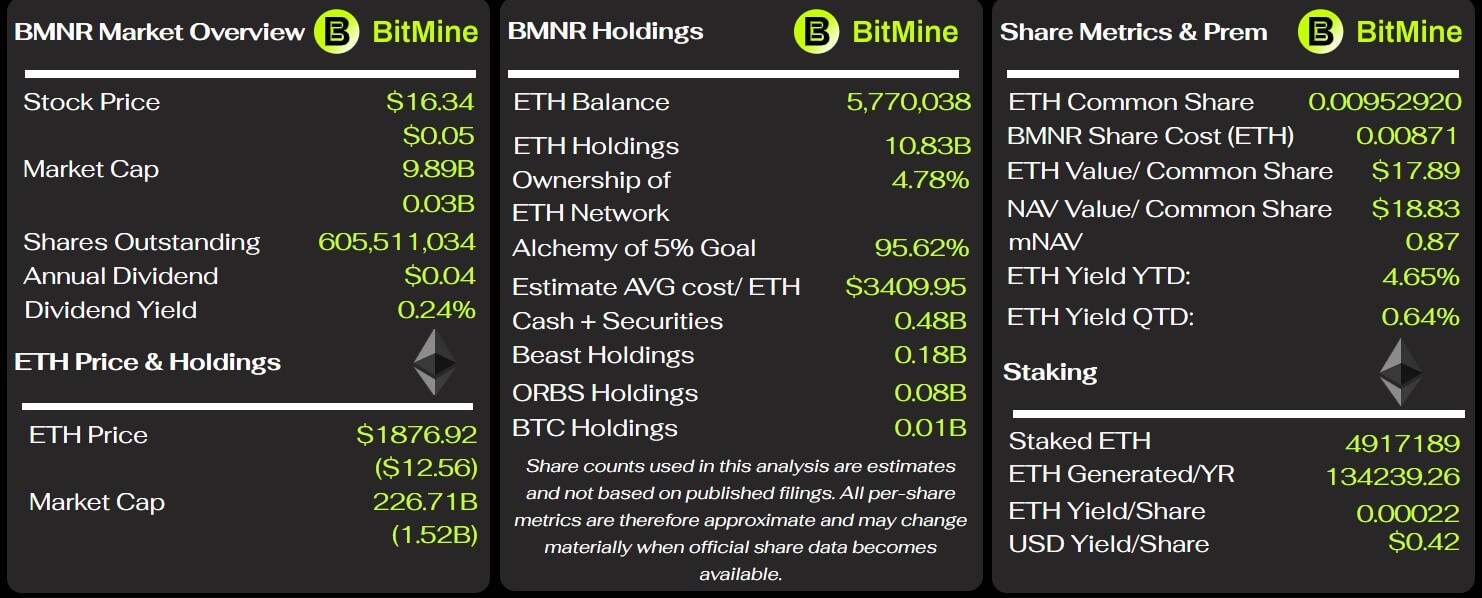
Meanwhile, the total holdings were valued at $10.86 billion on May 31, leaving the position approximately $8.2 billion, or 43%, below cost at quarter-end.
That decline drove most of the company’s $9.04 billion unrealized digital-asset loss during the first nine months of the fiscal year. BitMine posted a total net loss of $9.1 billion for the period.
The scale of the markdown highlights the exposure shareholders assumed as BitMine issued stock to acquire ETH at prices well above its May 31 carrying value.
Still, the company’s shareholders approved an increase in the authorized common shares from 500 million to 50 billion in January.
While the authorization does not require BitMine to issue the full amount, it gives management substantial capacity to continue raising equity for digital-asset purchases and other investments.
BitMine warned that its ability to expand the treasury depends partly on continued access to capital markets. A decline in ETH, a fall in BitMine’s share price, or weaker investor demand could make additional financing more expensive or restrict the company’s ability to issue securities on favorable terms.
The model therefore depends on more than staking yields and eventual Ethereum appreciation. It also requires shareholders to remain willing to finance further accumulation despite rapid dilution and a treasury position carrying a multibillion-dollar unrealized loss.
Long-term contracts raise the cost of producing ETH yield
As BitMine expands staking to offset treasury volatility, the agreements supporting those operations add fixed and revenue-linked expenses that narrow the strategy’s economics.
The company recorded $12.8 million in quarterly expenses under a 10-year consulting agreement with Ethereum Tower, a third-party service provider that provides consulting, asset management, custody, and staking services.
That amount was equal to roughly 28% of the staking and validation revenue generated during the period.
Expenses under the agreement reached $37.5 million during the first nine months of the fiscal year. BitMine expects the annual cost to range from $40 million to $50 million, based on a tiered fee calculated against the value of digital assets under management.
The agreement is noncancelable except under limited circumstances. If BitMine terminates it without cause, the company could be required to pay Ethereum Tower 85% of the fees that would otherwise have accrued through the remainder of the term.
Additionally, BitMine entered into a separate 10-year management services agreement with Ethereum Tower following the acquisition of Pier Two, the business behind its MAVAN validator operations.
Under that arrangement, Ethereum Tower received a 2% membership interest in MAVAN and became entitled to a monthly payment calculated as a percentage of native staking rewards generated through the platform.
BitMine had not recorded expenses under the second agreement as of May 31. The revenue-linked cost of that arrangement had therefore not yet appeared in the company’s reported staking margins.
The company said a substantial portion of its ETH holding was staked through MAVAN and that it expects staking rewards to exceed the cost of managing the assets.
The latest quarter provided early support for that expectation at the operating level. Staking revenue covered cost of sales and administrative expenses before crypto valuation changes.
However, the long-term consulting fees, future revenue-sharing payments, and broader treasury-management expenses mean that the economics cannot be measured by gross staking revenue alone.
No debt, but BitMine’s dependence on capital markets deepens
BitMine remained lightly leveraged at the end of May, with $340.3 million in cash, $433.1 million in working capital, and no conventional debt.
Total liabilities stood at approximately $30.1 million against $11.63 billion in reported assets, most of which consisted of Ethereum and other digital assets.
The balance sheet therefore did not indicate an immediate solvency crisis. However, BitMine used $287.6 million of cash in operating activities during the first nine months of the fiscal year.
The company said the outflow was influenced in part by legal, advisory, consulting, and capital-raising expenses associated with the expansion of its ETH treasury.
After the quarter, BitMine raised another $273.8 million by selling 3.5 million BMNP shares of 9.5% perpetual preferred stock.
The offering strengthened the company’s immediate liquidity, but it also introduced an estimated $33.25 million in annual preferred-dividend obligations. The securities are equity rather than conventional debt, though their position above common shareholders and high dividend rate add another recurring claim on BitMine’s resources.
Management said existing cash, anticipated operating cash flows, and access to its shelf registration and ATM program should provide sufficient liquidity for at least the next 12 months.
That assessment partly depends on continued access to capital markets. If Ethereum prices stagnate, BitMine shares weaken, or investors become less receptive to further issuance, the company could face higher financing costs or reduced flexibility.
BitMine’s latest filing therefore presents two competing realities.
The company has built a staking operation capable of generating tens of millions of dollars in quarterly revenue and covering its core operating expenses before crypto valuation changes.
At the same time, options losses have overwhelmed those gains, long-term contracts have added substantial management costs, and the expansion of the ETH treasury has relied on equity issuance, which has more than doubled the number of shares outstanding.
So, BitMine’s long-term economics will depend on whether staking income can consistently exceed treasury costs and options losses, whether the company can preserve access to capital, and whether Ethereum recovers enough to narrow the multibillion-dollar gap between the cost and market value of its holdings.