

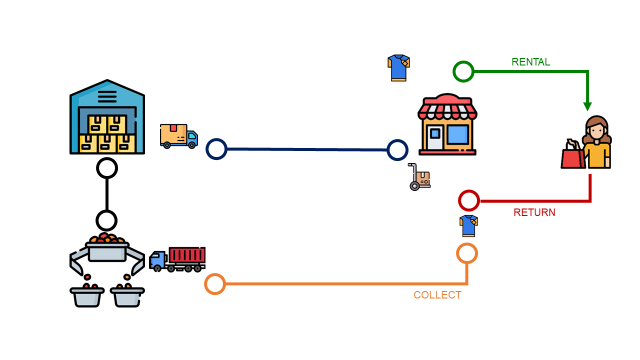
Now that we have built our model with the right assumptions, we can start exploring the results with a one-week rental period.
The percentage of circularity
What is the percentage of new items used?

💡 Insights
- During the first 12 days, the inventory of returned items is zero, so the store is using only new items for rental.
- When there are volume peaks, like on day 16, the accumulated inventory of returned items cannot meet the demand.
The percentage of circularity (%) is the ratio of returned items for the rental transactions.
This is an important parameter influencing the environmental performance of your circular model.
During the first 12 days, the footprint of your rental model is the highest as we are using new items.

This can be easily explained by looking at the volume of returned items.
Indeed, we can see that the first batch of rented items was returned on the 8th day.
After 5 days for the return process (pick-up, cleaning and store shipping), they are available on day 13 for new sales.

From this day, we have a balanced distribution of rented and returned items to obtain enough inventory to reuse more than 75% of items.
How many times an item is rented on average?
This chart shows the distribution of items by the number of rental cycles along the simulation period.

For instance, 9.8% of items have been used 10 times.
💡 Insights
- 110,458 unique items are used to fulfil 951,856 rental transactions
An average of 8.61 rental cycles per item. - Some items can reach 14 cycles.
- A non-negligible part of the inventory is only used a single time.
What is the environemental impact for each item?

Let us take the example of a coat rented to 35 customers using only 10 unique pieces.
We define the linear model’s emissions (co2_linear in green) as the total footprint if these customers purchased 35 coats items.
The circular model’s emissions (co2_circ in orange) only include the production of 10 unique coats and the logistics for return management.
Is there any correlation between emissions reductions and the number of rental cycles?
What is the impact of demand variability?
As expected, the amount of CO2e reduction is linearly linked with the number of cycles.

What does impact the percentage of reused items?
Therefore, we would like to reach 100% of rental transactions with reused items and limit the number of new items purchased.
What influences the percentage of transactions with reused items?
When demand is highly volatile, the inventory of returned items is quickly finished. Therefore, you need to purchase newly produced items.

In the example above, the demand distribution is highly skewed.
- 60% of the total demand for this reference occurs at the peak of day 105
- Therefore, the percentage of circularity (number of sales transactions fulfilled with reused items) is only 40%.
What if we have a stable demand?
The bar chart below shows the sales distribution of the SKU Garments 1018; this high runner has a stable distribution.

- Except for the first days, the demand distribution provides enough flexibility to build an inventory of returned products.
- Therefore, we can reach 89% of sales transactions with reused products.
With these two examples, you start to understand the correlation between demand variability and the coefficient of circularity.
Introduction of the coefficient of variation
Let me introduce the Coefficient of Variation CV:

A demand distribution can be considered volatile when CV > 1.
What is the variability of the 400 items included in the scope?

💡 Insights
- 99.9% of items with CV<1 have a percentage of circularity sales higher than 80%
- However, some items with CV > 1.5 have a percentage of circularity higher than 70%.
Logically, we can see the impact on the emissions reduction per item rented,

💡 Insights
- 100% of items with CV<1 have a reduction higher than 30 kg CO2e per Unit Rented.
As we do not control the demand variability, let’s explore the idea of increasing the emissions reductions by changing the rental period.