


Trading volumes across the top crypto assets have more than halved since 2025, and the technical picture is not helping – here is what the data actually shows.
Key Takeaways:
- Bitcoin is trading around $76,700, down nearly 5% over the past week.
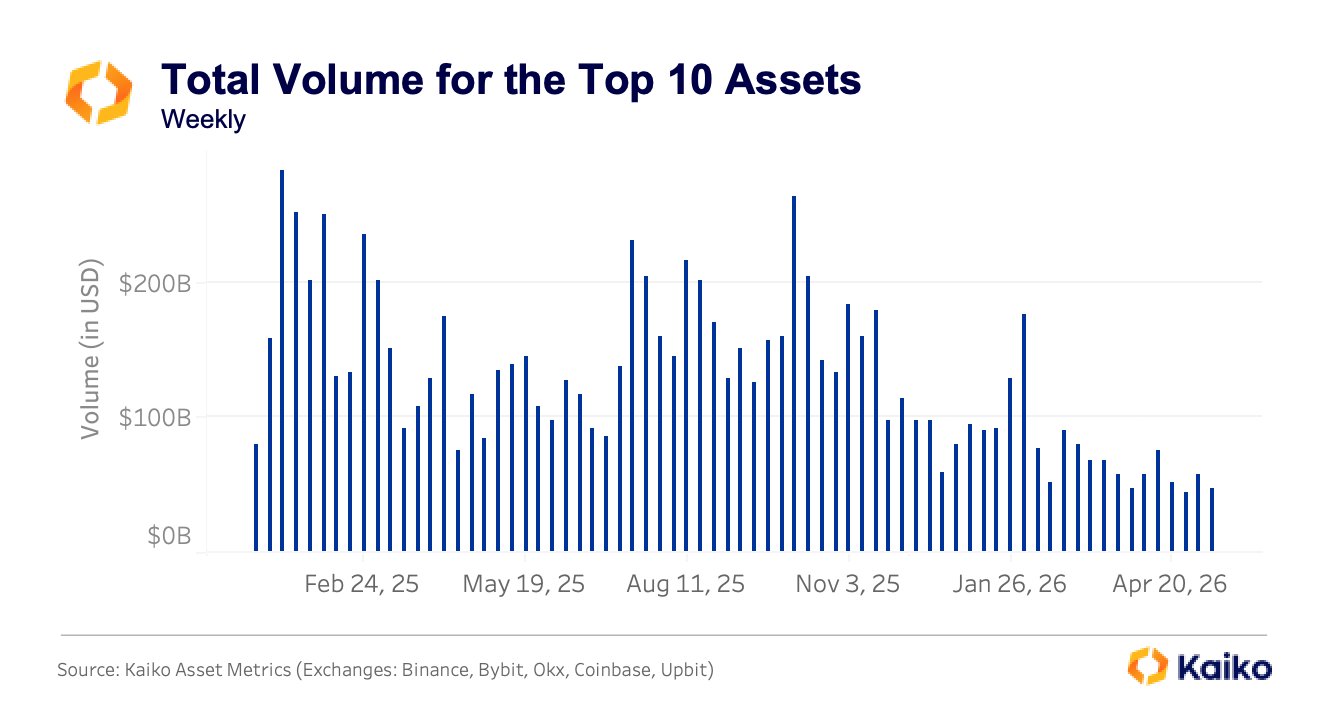
- Weekly spot volume for the top 10 crypto assets has collapsed to an average of $80B in 2026.
- Technical indicators point to momentum exhaustion.
- Institutional presence is cushioning volatility but has not stopped the slide.
Bitcoin is trading below $77,000, a level many market participants had treated as a reliable floor following the recent rebound above $80,000. BTC is down 4.63% over the past seven days, with a market cap sitting just above $1.5 trillion.
Volume Collapse Tells a Deeper Story
Data published by crypto analytics firm Kaiko puts the price action in sharper context. Spot volume across the top 10 digital assets has averaged $80 billion per week throughout 2026 – less than half the $178 billion weekly average recorded during 2025.
That is not merely a price correction – it reflects a broad contraction in market participation that makes any sustained recovery harder to achieve without a meaningful influx of new capital.
Each Rally Is Weaker Than the Last
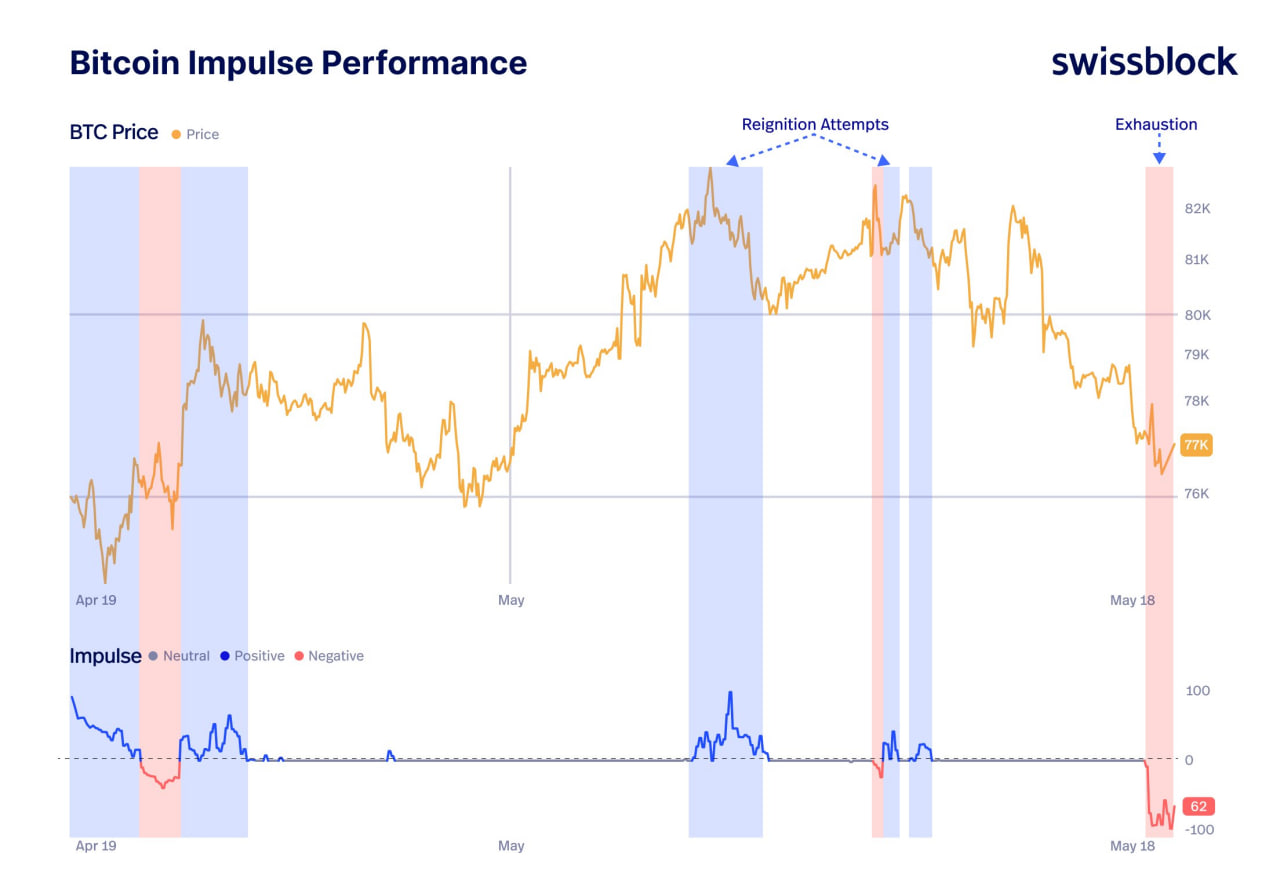
Running alongside the volume data is a technical picture that analysts at Swissblock are describing as momentum exhaustion.
The pattern is recognisable: each attempt to reignite upward price movement fails at a lower level than the one before it, positive impulse fades faster with every bounce, and the metric collapses back into negative territory before buyers can establish any kind of foothold.
Swissblock is explicit that this is not yet aggressive downside pressure – it is something more gradual, a progressive erosion of the market’s internal capacity to drive prices higher. Historically, these periods of exhaustion have preceded more significant breakdowns rather than recoveries.
Why This Is Not New Territory for Bitcoin
Research from Arkham Intelligence notes that BTC has historically followed four-year boom-and-bust cycles, with sharp corrections typically arriving after periods of sustained euphoria.
The triggers vary considerably: excessive leverage building up in the system, macroeconomic shifts pulling capital away from risk assets, or regulatory shocks creating sudden loss of confidence.
On January 29, 2026, a disappointing session for US tech stocks was enough to nudge Bitcoin’s price lower and set off a liquidation cascade, where margin calls triggered automatic sell orders that pushed the price down further in a self-reinforcing spiral. The initial move was modest; the knock-on effect was not.
Institutions Are Cushioning the Fall – But Not Stopping It
The current situation has not, at least so far, involved that kind of external shock. The volume decline is gradual rather than panicked. Institutional involvement – through vehicles like BlackRock’s Bitcoin ETF, which became a market reality during the 2025 cycle – provides a degree of stabilisation that was absent in earlier bear markets, since large institutional allocators do not react to short-term price dips the way retail participants do.
Even so, that structural support has not been enough to prevent BTC from sliding roughly 5% on the week and sitting well below its 2025 peaks.
What Low Volume Actually Means for the Market
For anyone with exposure to the market, low volume is an ambiguous signal. The absence of a sharp sell-off suggests there is no mass panic. At the same time, thin participation means there is no significant buying pressure either, leaving prices vulnerable to sudden moves in either direction.
Any unexpected macro data, regulatory headline, or wave of altcoin liquidations – which historically amplify Bitcoin’s downside moves – could shift the picture quickly. Smaller tokens tend to fall harder and faster than BTC in these conditions, as risk appetite retreats to what investors perceive as the more defensible end of the asset class.
Whether the $76,000-$77,000 range holds as a demand zone or turns out to be a temporary pause before the next leg lower will largely depend on whether volume returns to more convincing levels in the sessions ahead.
The information provided in this article is for educational purposes only and does not constitute financial, investment, or trading advice. Coindoo.com does not endorse or recommend any specific investment strategy or cryptocurrency. Always conduct your own research and consult with a licensed financial advisor before making any investment decisions.

Alex is Editor-in-Chief of Coindoo and co-founder of Millennial Media Group, with nearly a decade of experience covering financial markets – crypto first, then everything else.
It started in 2016 with Bitcoin. Like most people at the time, he didn’t fully understand it – so he kept digging. Blockchain, tokenomics, the projects, the cycles. That curiosity never stopped, and eventually pulled him into traditional markets too: equities, commodities, macro. Not because he left crypto behind, but because you can’t properly understand one without the other.
What drives him is straightforward: he wants to know why something is happening, not just that it’s happening. Most market coverage stops at the headline – price up, price down, here’s a chart. Alex finds that kind of reporting actively unhelpful. If you walk away from an article without understanding the mechanism behind the move, what did you actually learn?
He holds a degree in Tourism from New Bulgarian University – not the most obvious path into financial markets, but markets have a way of pulling in people who are simply too curious to stay out. He has authored over 200 in-depth analyses and more than 10,000 articles across crypto and traditional finance. He still thinks every day in markets teaches him something new. That’s probably why he hasn’t stopped.