

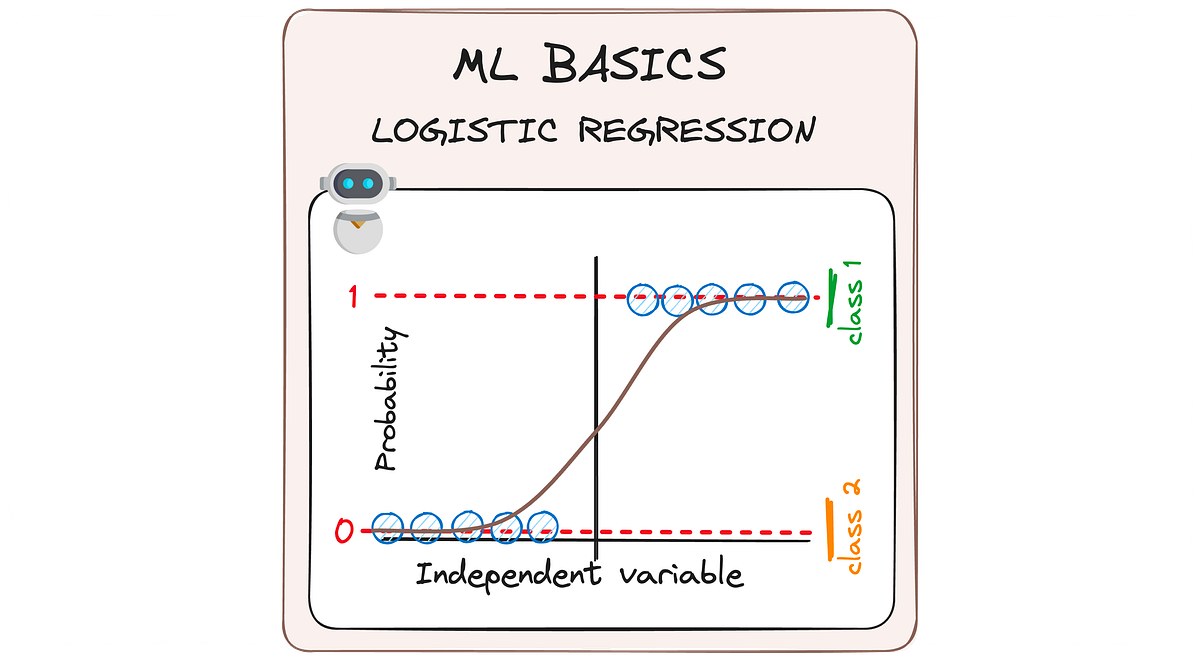


In the world of data and computer programs, the concept of Machine Learning might sound like a tough nut to crack, full of tricky math and complex ideas.
This is why today I want to slow down and check out the basic stuff that makes all this work with a new issue of my MLBasics series.
We’re going to revisit the simple, yet super-important, models that are the ABCs of ML. Think of it as starting with the easy pieces of a big puzzle. We’re going back to the simple stuff, where it’s easy to get what’s going on.
So come along for the ride as we break it down and make it all clear.
Let’s dive into Logistic Regression, step by step, together! 👇🏻🤓
In the vast expanse of ML algorithms, Logistic Regression stands as an optimal model for binary classification problems.
It is the trusted path we take when the terrain is categorical, and the destination is decision-making.
Logistic Regression is not merely a statistical tool but a storytelling device that translates numerical tales into binary outcomes.
Imagine you are at a crossroads where each path leads to a distinct outcome, and your choice is binary: yes or no, true or false, A or B.
Logistic regression is the queen in this field of dichotomies.
At its core, Logistic Regression is about probabilities. It measures the likelihood of an event occurring.
Its main goal? 🎯
Logistic regression aims to find the probability that a given input belongs to a certain class.
