

The Coding Implementation
Before we can implement the equations above, we’ll need to import the necessary dataset, preprocess and ready for the model training. All of this work is very standard in any time series analysis.
import numpy as np
import pandas as pd
import matplotlib.pyplot as plt
import plotly.graph_objs as go
from plotly.offline import iplot
import yfinance as yf
import datetime as dt
import math#### Data Processing
start_date = dt.datetime(2020,4,1)
end_date = dt.datetime(2023,4,1)
#loading from yahoo finance
data = yf.download("GOOGL",start_date, end_date)
pd.set_option('display.max_rows', 4)
pd.set_option('display.max_columns',5)
display(data)
# #Splitting the dataset
training_data_len = math.ceil(len(data) * .8)
train_data = data[:training_data_len].iloc[:,:1]
test_data = data[training_data_len:].iloc[:,:1]
dataset_train = train_data.Open.values
# Reshaping 1D to 2D array
dataset_train = np.reshape(dataset_train, (-1,1))
dataset_train.shape
scaler = MinMaxScaler(feature_range=(0,1))
# scaling dataset
scaled_train = scaler.fit_transform(dataset_train)
dataset_test = test_data.Open.values
dataset_test = np.reshape(dataset_test, (-1,1))
scaled_test = scaler.fit_transform(dataset_test)
X_train = []
y_train = []
for i in range(50, len(scaled_train)):
X_train.append(scaled_train[i-50:i, 0])
y_train.append(scaled_train[i, 0])
X_test = []
y_test = []
for i in range(50, len(scaled_test)):
X_test.append(scaled_test[i-50:i, 0])
y_test.append(scaled_test[i, 0])
# The data is converted to Numpy array
X_train, y_train = np.array(X_train), np.array(y_train)
#Reshaping
X_train = np.reshape(X_train, (X_train.shape[0], X_train.shape[1],1))
y_train = np.reshape(y_train, (y_train.shape[0],1))
print("X_train :",X_train.shape,"y_train :",y_train.shape)
# The data is converted to numpy array
X_test, y_test = np.array(X_test), np.array(y_test)
#Reshaping
X_test = np.reshape(X_test, (X_test.shape[0], X_test.shape[1],1))
y_test = np.reshape(y_test, (y_test.shape[0],1))
The model
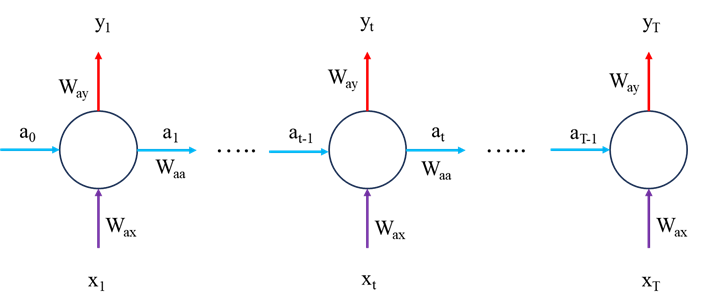
Now we implement the mathematical equations. it is definitely worth reading through the code, noting the dimensions of all variables and respective derivates to give yourself a better understanding of these equations.
class SimpleRNN:
def __init__(self,input_dim,output_dim, hidden_dim):
self.input_dim = input_dim
self.output_dim = output_dim
self.hidden_dim = hidden_dim
self.Waa = np.random.randn(hidden_dim, hidden_dim) * 0.01 # we initialise as non-zero to help with training later
self.Wax = np.random.randn(hidden_dim, input_dim) * 0.01
self.Way = np.random.randn(output_dim, hidden_dim) * 0.01
self.ba = np.zeros((hidden_dim, 1))
self.by = 0 # a single value shared over all outputs #np.zeros((hidden_dim, 1))def FeedForward(self, x):
# let's calculate the hidden states
a = [np.zeros((self.hidden_dim,1))]
y = []
for ii in range(len(x)):
a_next = np.tanh(np.dot(self.Waa, a[ii])+np.dot(self.Wax,x[ii].reshape(-1,1))+self.ba)
a.append(a_next)
y_local = np.dot(self.Way,a_next)+self.by
y.append(np.dot(self.Way,a_next)+self.by)
# remove the first a and y values used for initialisation
#a = a[1:]
return y, a
def ComputeLossFunction(self, y_pred, y_actual):
# for a normal many to many model:
#loss = np.sum((y_pred - y_actual) ** 2)
# in our case, we are only using the last value so we expect scalar values here rather than a vector
loss = (y_pred[-1] - y_actual) ** 2
return loss
def ComputeGradients(self, a, x, y_pred, y_actual):
# Backpropagation through time
dLdy = []
dLdby = np.zeros((self.output_dim, 1))
dLdWay = np.random.randn(self.output_dim, self.hidden_dim)/5.0
dLdWax = np.random.randn(self.hidden_dim, self.input_dim)/5.0
dLdWaa = np.zeros((self.hidden_dim, self.hidden_dim))
dLda = np.zeros_like(a)
dLdba = np.zeros((self.hidden_dim, 1))
for t in range(self.hidden_dim-1, 0, -1):
if t == self.hidden_dim-1:
dldy = 2*(y_pred[t] - y_actual)
else:
dldy = 0
dLdy.append(dldy)
#dLdby.append(dldy)
dLdby += dldy
#print(dldy.shape)
dLdWay += np.dot(np.array(dldy).reshape(-1,1), a[t].T)
# Calculate gradient of loss with respect to a[t]
if t == self.hidden_dim-1:
dlda_t= np.dot(self.Way.T, np.array(dldy).reshape(-1,1))
else:
dlda_t = np.dot(self.Way.T, np.array(dldy).reshape(-1,1)) + np.dot(self.Waa, dLda[t+1]) * (1 - a[t]**2)
dLda[t] = dlda_t
#print(dlda_t.shape)
rec_term = (1-a[t]*a[t])
dLdWax += np.dot(dlda_t, x[t].reshape(-1,1))*rec_term
dLdWaa += np.dot(dlda_t, a[t-1].T)*rec_term
dLdba += dlda_t*rec_term
return dLdy[::-1], dLdby[::-1], dLdWay, dLdWax, dLdWaa, dLdba
def UpdateParameters(self,dLdby, dLdWay, dLdWax, dLdWaa, dLdba,learning_rate):
self.Waa -= learning_rate * dLdWaa
self.Wax -= learning_rate * dLdWax
self.Way -= learning_rate * dLdWay
self.ba -= learning_rate * dLdba
self.by -= learning_rate * dLdby
def predict(self, x, n, a_training):
# let's calculate the hidden states
a_future = a_training
y_predict = []
# Predict the next n terms
for ii in range(n):
a_next = np.tanh(np.dot(self.Waa, a_future[-1]) + np.dot(self.Wax, x[ii]) + self.ba)
a.append(a_next)
y_predict.append(np.dot(self.Way, a_next) + self.by)
return y_predict
Training and Testing the model
input_dim = 1
output_dim = 1
hidden_dim = 50learning_rate = 1e-3
# Initialize The RNN model
rnn_model = SimpleRNN(input_dim, output_dim, hidden_dim)
# train the model for 200 epochs
for epoch in range(200):
for ii in range(len(X_train)):
y_pred, a = rnn_model.FeedForward(X_train[ii])
loss = rnn_model.ComputeLossFunction(y_pred, y_train[ii])
dLdy, dLdby, dLdWay, dLdWax, dLdWaa, dLdba = rnn_model.ComputeGradients(a, X_train[ii], y_pred, y_train[ii])
rnn_model.UpdateParameters(dLdby, dLdWay, dLdWax, dLdWaa, dLdba, learning_rate)
print(f'Loss: loss')
y_test_predicted = []
for jj in range(len(X_test)):
forecasted_values, _ = rnn_model.FeedForward(X_test[jj])
y_test_predicted.append(forecasted_values[-1])
y_test_predicted_flat = np.array([val[0, 0] for val in y_test_predicted])
trace1 = go.Scatter(y = y_test.ravel(), mode ="lines", name = "original data")
trace2 = go.Scatter(y=y_test_predicted_flat, mode = "lines", name = "RNN output")
layout = go.Layout(title='Testing data Fit', xaxis=dict(title='X-Axis'), yaxis=dict(title='Dependent Variable'))
figure = go.Figure(data = [trace1,trace2], layout = layout)
iplot(figure)

That brings us to the end of this demonstration but hopefully only the start of your reading into these powerful models. You might find it helpful to test your understanding by experimenting with a different activation function in the forward pass. Or read further into sequential models like LSTM and transformers which are formidable tools, especially in language-related tasks. Exploring these models can deepen your understanding of more sophisticated mechanisms for handling temporal dependencies. Finally, thank you for taking the time to read this article, I hope you found it useful in your understanding of RNN or their mathematical background.
Unless otherwise noted, all images are by the author