


by Evan Feng & Dmitry Lapidus

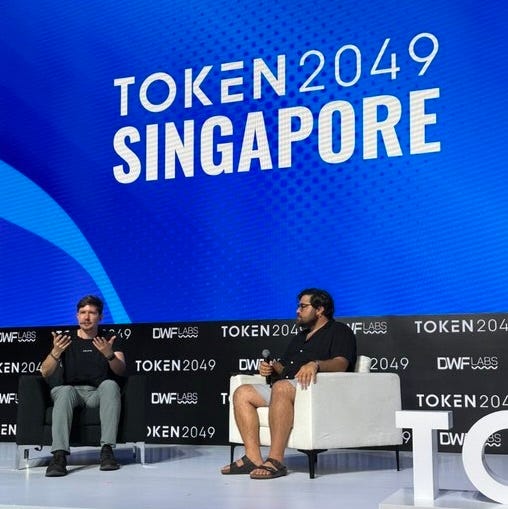
After a brief conference hiatus and a critical summer of crypto regulatory uncertainty in the US, it was a fitting time to head to Singapore for one of the year’s largest crypto conferences. This year’s TOKEN2049 event was a global showcase for web3, and emphasized the importance of building real-world use cases of blockchain adoption.
The event brought together builders, investors, local and international retail, and a record number of executives speaking at the event including Ethereum Co-founder Vitalik Buterin, Binance CEO Richard Teng, Polymarket CEO Shayne Coplan, and, perhaps unexpectedly, rapper and $MOTHER memecoin creator Iggy Azalea. After hours, attendees flocked to curated networking dinners, partied at large scale brand-marketing events, and coded at hackathons for Solana Breakpoint — the network’s annual conference that followed TOKEN2049.
On the ground, builders showed strong interest in improving security and user-experience onchain, with a goal of abstracting web3 complexities away to help usher in mainstream adoption. Given this narrative, we noticed that TOKEN2049 had more consumers in attendance than the Ethereum-focused Devcon event series, and felt similar to the early retail-oriented Consensus conferences.
Tapping into Asia’s Web3 Ecosystem
Alongside Hong Kong, Singapore remains one of the dual crypto hubs for Asia. Singapore is becoming an increasingly important Eastern hub for web3, with many exchanges, startups, and investment firms having a strong presence in the country. When compared to the US, Asia-based crypto projects noticeably have a stronger focus on consumer applications and the power of memetics to drive distribution as seen in the TON ecosystem as it strives to emulate the success of WeChat’s mini-apps. Instead of the technology behind a product being its sole winning differentiator, local investors also tend to look for prior Western VC investment as a proxy for future success and market relevance. CoinFund has local Asian Investment Team members, and by attending TOKEN2049 to represent the brand, speak on panels, attend events, and meet with founders across the ecosystem, the team is working to grow the existing number of Asia-based founders across our portfolio. We remain excited about the region and continue to see signs of a large and continuously growing opportunity set of projects, developers, ecosystems, users, investors, allocators and more that drive a lot of activity and innovation.
Current Crypto Narratives & TOKEN Takeaways
The current conversations in web3 tend to revolve around consumer-facing products in DePIN, DeAI, and many projects are also focusing on gaming. Regardless of web3’s recent technological innovations, the event focused heavily on US elections, which was surprising, considering the context of the event. While the market is still looking for signs of improved US regulatory clarity following the upcoming election, builders in attendance were excited about making consumer-focused web3 products and applications.
Aside from regulation, there were several global narratives that dominated the event. Solana has started to grab the eyes of the mainstream, as it shows signs of institutional adoption with Franklin Templeton announcing the launch of a tokenized mutual fund on the network. Similarly, long-running Ethereum project Sky, formerly known as MakerDAO, is expanding its native USDS stablecoin to Solana — an important step in increased adoption on the network.
Gaming has begun to resurge as an important area for crypto adoption. While TON-based building has dominated the gaming narrative over the past several months, as 2025 approaches, we heard stronger belief among attendees that gaming could reemerge as a more proven source of new user adoption to web3 at a more sustainable and broad-based level of success across multiple L1 and L2 ecosystems. As we head into the next year, projects are focused on creating value capture in-wallet, with discussions around a growing trend of onchain messaging and mini-app combinations, similar to Telegram. With increased focus on building consumer infrastructure and abstracted onchain experiences, crypto adoption will likely grow with these new use cases across new regions.