


Despite their output being ultimately consumed by human viewers, 3D Gaussian Splatting (3DGS) methods often rely on ad-hoc combinations of pixel-level losses, resulting in blurry renderings. To address this, we systematically explore perceptual optimization strategies for 3DGS by searching over a diverse set of distortion losses. We conduct the first-of-its-kind large-scale human subjective study on 3DGS, involving 39,320 pairwise ratings across several datasets and 3DGS frameworks. A regularized version of Wasserstein Distortion, which we call WD-R, emerges as the clear winner, excelling at recovering fine textures without incurring a higher splat count. WD-R is preferred by raters more than 2.3× over the original 3DGS loss, and 1.5× over current best method Perceptual-GS. WD-R also consistently achieves state-of-the-art LPIPS, DISTS, and FID scores across various datasets, and generalizes across recent frameworks, such as Mip-Splatting and Scaffold-GS, where replacing the original loss with WD-R consistently enhances perceptual quality within a similar resource budget (number of splats for Mip-Splatting, model size for Scaffold-GS), and leads to reconstructions being preferred by human raters 1.8× and 3.6×, respectively. We also find that this carries over to the task of 3DGS scene compression, with ≈50% bitrate savings for comparable perceptual metric performance.
- † New York University (Tandon School of Engineering)
- ‡ Equal contribution
Figure 1: 3DGS representation and compression frameworks optimized using 2D distortion and rate-distortion objectives, incorporating perceptual losses as part of the training framework.
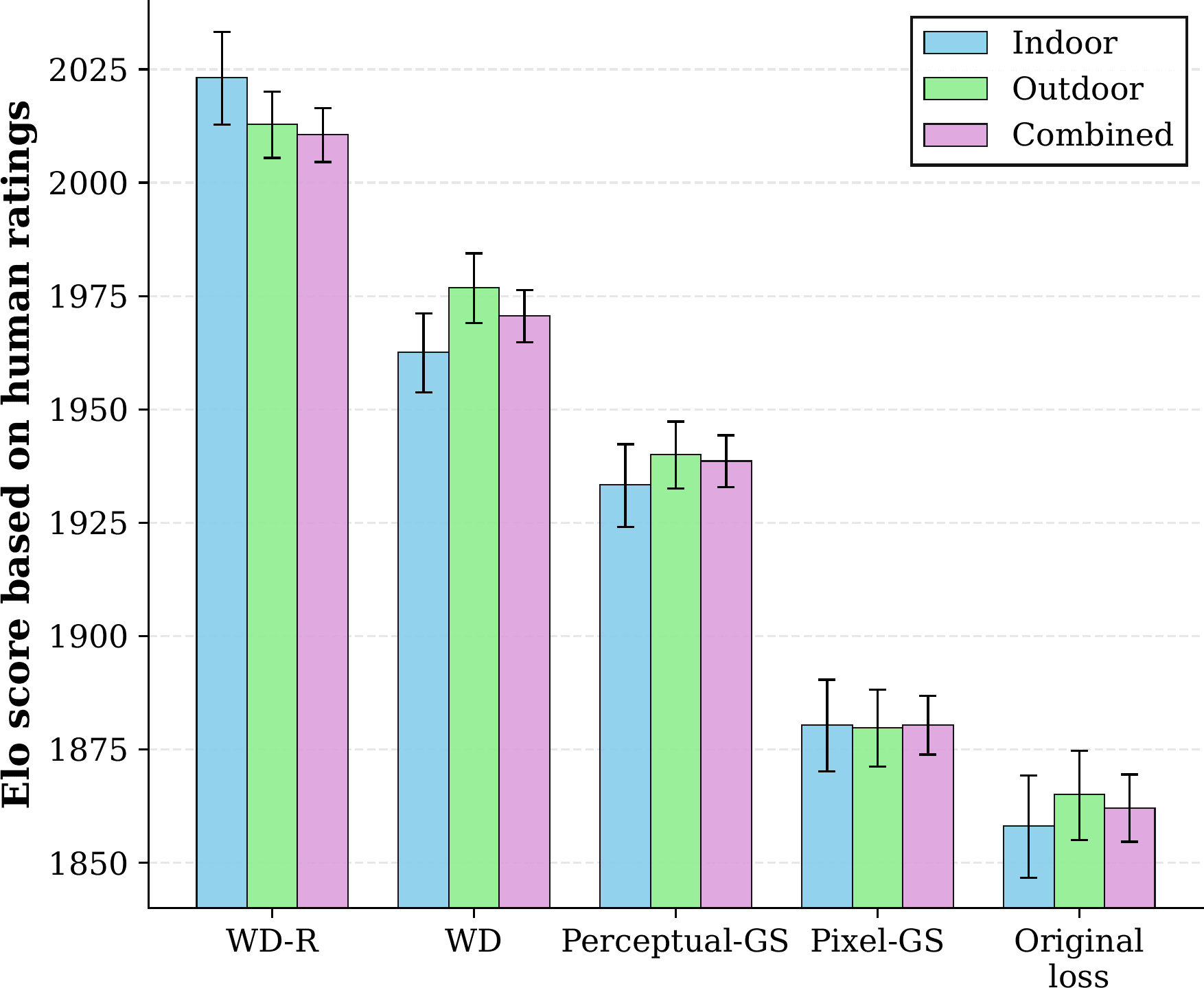
Figure 2: Bayesian Elo scores for 3DGS representation methods across indoor scenes (Deep Blending, Mip-NeRF 360 indoor), outdoor scenes (Tanks & Temples, Mip-NeRF 360 outdoor, and BungeeNeRF), and all scenes combined. WD-R and WD achieve the highest scores in all settings (within the 95% confidence interval).