

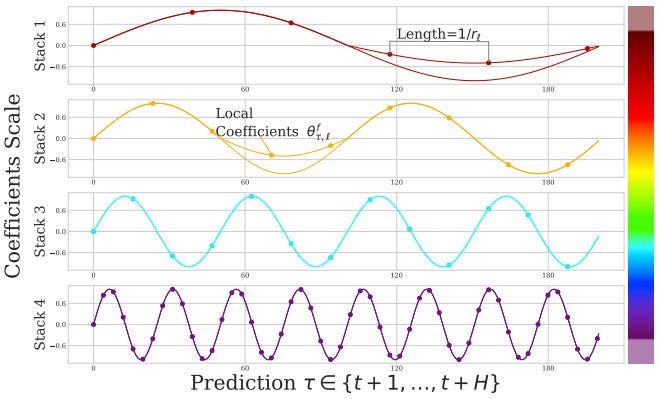


NHiTS was published 2 years ago — and has gained significant attention in the forecasting community since then.
First, it’s a versatile model — accepting past observations, future known inputs, and static exogenous variables. It can be applied across various forecasting domains, including energy demand, retail, and financial markets.
It’s lightweight, yet high-performance. Unlike typical DL models that rely on “slapping“ hidden layers, this model leverages signal theory concepts to boost performance with minimal parameters.
Finally, its multi-rate signal sampling strategy enables the model to capture complex frequency patterns — essential for areas like financial forecasting. The model can be used for probabilistic forecasting too.
In this article, we will explain NHiTS in detail, analyze its architecture, and highlight its strengths and inner workings with practical examples.
Let’s get started.
✅ Find the hands-on project for NHITS in the AI Projects folder (Project 2) of my newsletter, along with other cool projects! Don’t forget to subscribe!