

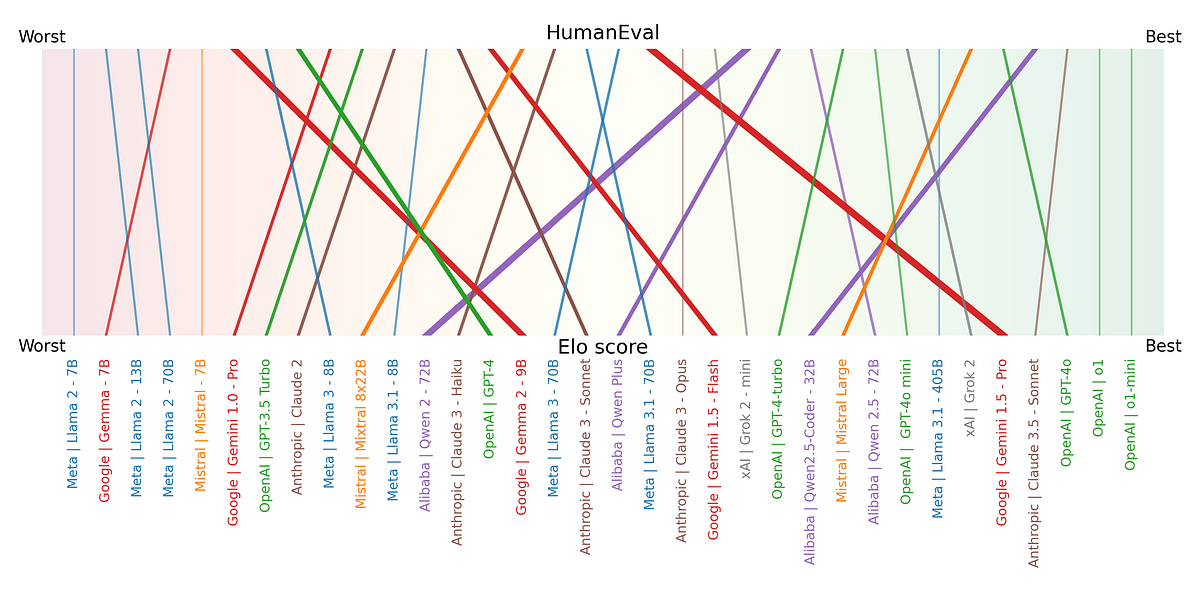
As hinted at in the disclaimer above, to properly understand how LLMs perform in coding tasks, it’s advisable to evaluate them from multiple perspectives.
Benchmarking through HumanEval
Initially, I tried to aggregate results from several benchmarks to see which model comes out on top. However, this approach had as core problem: different models use different benchmarks and configurations. Only one benchmark seemed to be the default for evaluating coding performance: HumanEval. This is a benchmark dataset consisting of human-written coding problems, evaluating a model’s ability to generate correct and functional code based on specified requirements. By assessing code completion and problem-solving skills, HumanEval serves as a standard measure for coding proficiency in LLMs.
The voice of the people through Elo scores
While benchmarks give a good view of a model’s performance, they should also be taken with a grain of salt. Given the vast amounts of data LLMs are trained on, some of a benchmark’s content (or highly similar content) might be part of that training. That’s why it’s beneficial to also evaluate models based on how well they perform as judged by humans. Elo ratings, such as those from Chatbot Arena (coding only), do just that. These are scores derived from head-to-head comparisons of LLMs in coding tasks, evaluated by human judges. Models are pitted against each other, and their Elo scores are adjusted based on wins and losses in these pairwise matches. An Elo score shows a model’s relative performance compared to others in the pool, with higher scores indicating better performance. For example, a difference of 100 Elo points suggests that the higher-rated model is expected to win about 64% of the time against the lower-rated model.
Current state of model performance
Now, let’s examine how these models perform when we compare their HumanEval scores with their Elo ratings. The following image illustrates the current coding landscape for LLMs, where the models are clustered by the companies that created them. Each company’s best performing model is annotated.

OpenAI’s models are at the top of both metrics, demonstrating their superior capability in solving coding tasks. The top OpenAI model outperforms the best non-OpenAI model — Anthropic’s Claude Sonnet 3.5 — by 46 Elo points , with an expected win rate of 56.6% in head-to-head coding tasks , and a 3.9% difference in HumanEval. While this difference isn’t overwhelming, it shows that OpenAI still has the edge. Interestingly, the best model is o1-mini, which scores higher than the larger o1 by 10 Elo points and 2.5% in HumanEval.
Conclusion: OpenAI continues to dominate, positioning themselves at the top in benchmark performance and real-world usage. Remarkably, o1-mini is the best performing model, outperforming its larger counterpart o1.
Other companies follow closely behind and seem to exist within the same “performance ballpark”. To provide a clearer sense of the difference in model performance, the following figure shows the win probabilities of each company’s best model — as indicated by their Elo rating.
