


The crypto market extended its decline on March 18, with fresh outflows from spot exchange-traded funds adding pressure to already weakening price action.
Key Takeaways
- Bitcoin ETF flows turned negative, with roughly $130 million in net outflows.
- Ethereum ETFs also recorded net outflows of about $55 million.
- Bitcoin fell below $70,000, while Ethereum dropped under $2,200.
Bitcoin fell toward the $69,000 level, while Ethereum dropped below $2,200, as institutional demand showed signs of stalling after a strong start to the month.
ETF Outflows Break Momentum
Bitcoin ETF flows flipped negative on March 18, with total net outflows of approximately $129.6 million. According to data from Farside Investors the largest redemptions came from BlackRock’s IBIT, which saw more than $100 million in outflows, alongside smaller withdrawals across other issuers including Fidelity and Bitwise products.
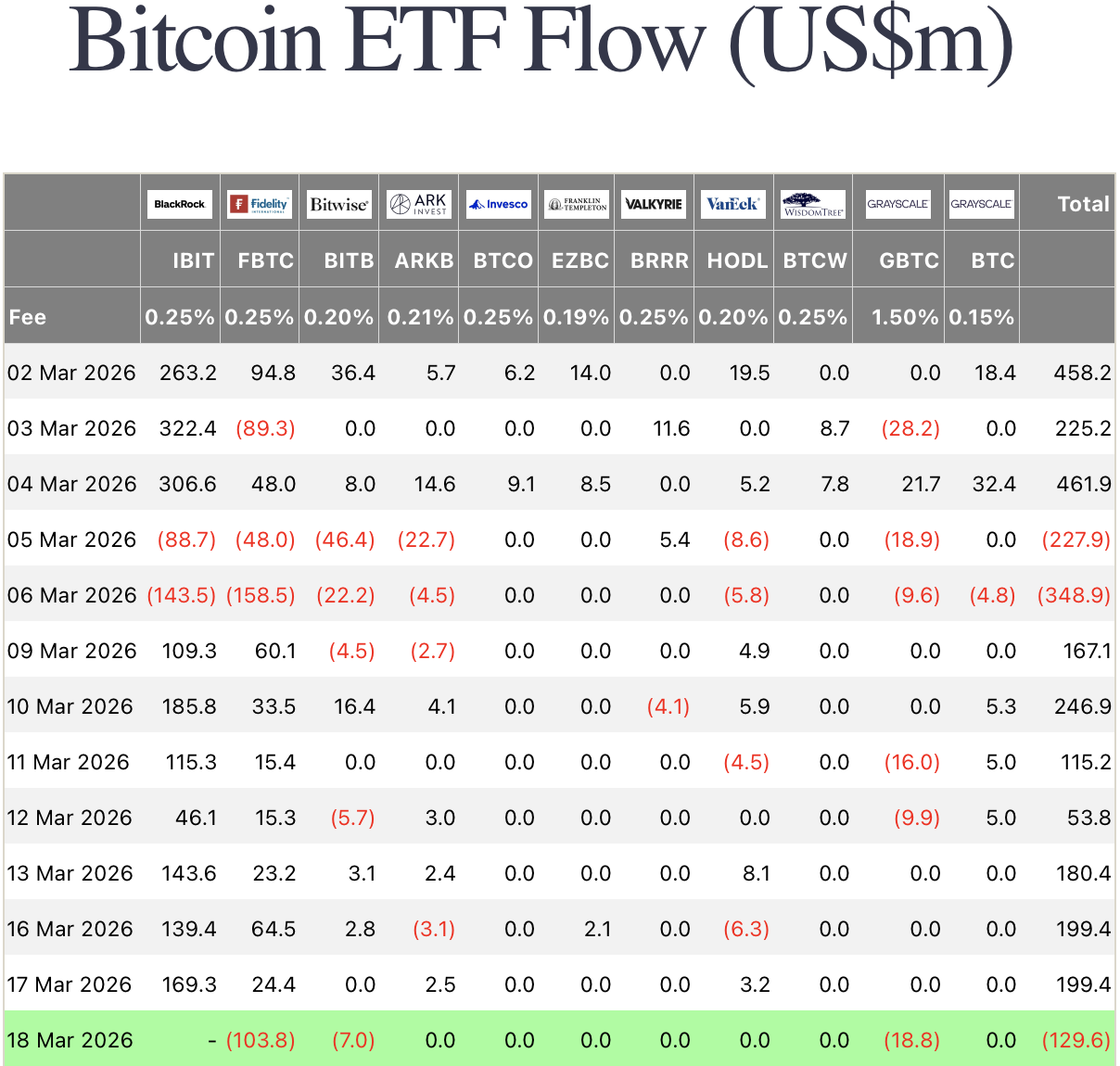
The reversal is notable after several sessions of steady inflows earlier in the week, suggesting that institutional demand has become more sensitive to short-term price action. While ETF flows had been a key driver of Bitcoin’s resilience near recent highs, the shift highlights how quickly that support can fade when momentum weakens.
Ethereum ETFs followed a similar pattern, posting roughly $55.5 million in net outflows. Losses were concentrated across multiple funds, with no meaningful offsetting inflows, reinforcing the idea that institutional capital is pulling back broadly rather than rotating within the asset class.
Liquidations Surge as $588 Million in Positions Wiped Out
The market downturn triggered a sharp wave of forced liquidations, with $588.1 million in total positions wiped out over the past 24 hours, according to Coinglass data. The overwhelming majority came from long positions, underscoring how heavily the market had been positioned for further upside.
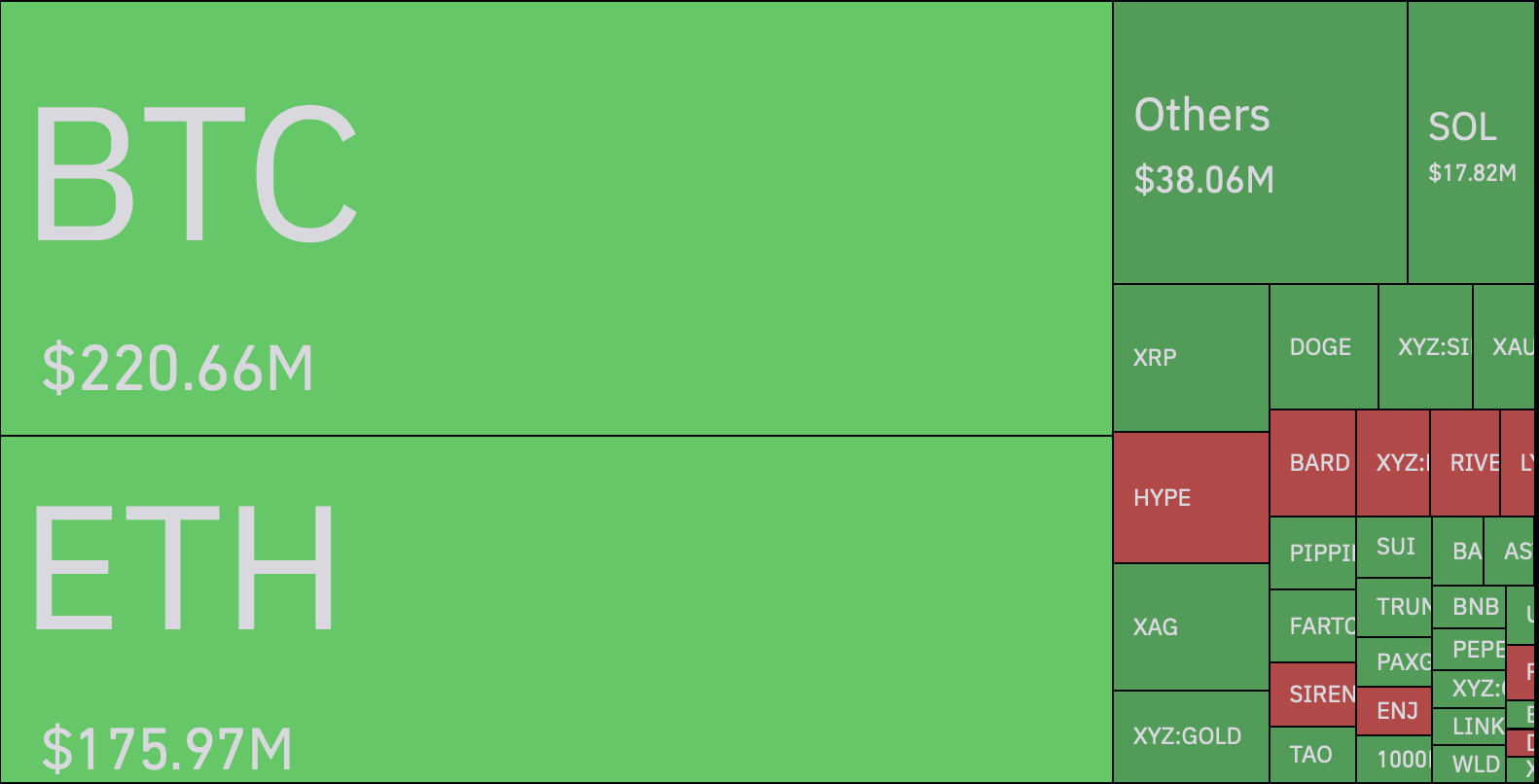
Of that total, approximately $492.8 million were long liquidations, compared to just $95.3 million in short liquidations. The imbalance highlights a classic long squeeze, where bullish positioning is unwound rapidly as prices break lower.
Bitcoin accounted for the largest share of liquidations at roughly $220.7 million, followed by Ethereum at $176.0 million, with the remainder spread across altcoins. The concentration in major assets reflects where the bulk of leveraged exposure had accumulated during the recent rally.
More than 158,000 traders were liquidated during the move, with the largest single liquidation order reaching nearly $18 million on an ETH position. The scale of the unwind suggests that leverage had built up significantly across derivatives markets before the correction began.
The liquidation cascade amplified the price decline, as forced selling from margin calls added mechanical pressure on top of spot market weakness. This dynamic is typical in crypto markets, where high leverage can turn relatively modest price moves into accelerated selloffs.
At the same time, the flush may serve a stabilizing role. By clearing excessive leverage and resetting positioning, the market can rebuild on a more sustainable footing – provided that selling pressure begins to ease and new demand emerges.
From Flow-Driven Rally to Liquidity Test
The current pullback highlights how dependent the recent rally had become on sustained institutional inflows. With ETF demand moderating and, in some cases, reversing, prices are now testing whether organic spot demand can support current levels.
At the same time, positioning dynamics are likely amplifying the move. After an extended period of gains, leveraged long exposure left the market vulnerable to liquidations once prices began to slip. As those positions unwind, volatility tends to increase, creating sharper downside moves.
Macro conditions also remain a factor. Crypto continues to trade as a high-beta risk asset, meaning shifts in broader financial conditions can quickly translate into price pressure. In this environment, the absence of strong inflows becomes more pronounced.
For now, the key question is whether ETF flows stabilize or continue to deteriorate. If outflows persist, the market may face a deeper retracement. If inflows return, they could once again act as a stabilizing force.
What is clear is that the balance of power has shifted – at least temporarily – from buyers to sellers, with flows, momentum, and sentiment all aligning in the same direction.
The information provided in this article is for educational purposes only and does not constitute financial, investment, or trading advice. Coindoo.com does not endorse or recommend any specific investment strategy or cryptocurrency. Always conduct your own research and consult with a licensed financial advisor before making any investment decisions.