




The SEC approved Nasdaq PHLX’s proposed rule change to list Nasdaq Bitcoin Index Options on May 22, clearing a major regulatory step toward bringing cash-settled Bitcoin volatility trading inside the US-listed options infrastructure.
The contracts, ticker QBTC, are cash-settled in US dollars against a Bitcoin benchmark and fit within the same account and margin framework used for equity index options.
That places QBTC in the market for cash-settled Bitcoin options without requiring investors to hold BTC or use crypto-native derivatives venues.
Trading begins only once the CFTC grants the necessary exemptive relief and the OCC receives approval to update the Options Disclosure Document, but that approval restructures what Bitcoin can be inside the machinery Wall Street uses every day.
Spot Bitcoin ETFs gave traditional investors regulated price exposure to BTC, and options on those ETFs added hedging and speculation tools tied to specific fund shares. The distinction matters because Bitcoin ETF options track fund shares, while Nasdaq Bitcoin index options would reference a Bitcoin benchmark directly.
QBTC creates an options market around Bitcoin exposure itself, inside the listed-index-options stack, priced against a real-time Bitcoin benchmark and cleared through OCC’s standard infrastructure.
The SEC order describes the contracts as European-style, P.M.-settled, and cash-settled, with final settlement value based on BRRNY, a New York close Bitcoin benchmark synchronized to 4:00 p.m. Eastern time.
The underlying index is the CME CF Bitcoin Real Time Index (BRTI), divided by 100, with CF Benchmarks calculating the indicative value every 200 milliseconds during the trading day.
Nasdaq argued in its filing that the index options would allow investors in spot Bitcoin ETFs to hold QBTC contracts in the same securities account and under the same margin regime as their ETF exposure, integrating Bitcoin risk management into existing securities account workflows.
| Product layer | What it gives investors | Market infrastructure | Limitation |
|---|---|---|---|
| Spot Bitcoin ETFs | Regulated BTC price exposure | Securities account / ETF wrapper | Mostly directional exposure |
| Bitcoin ETF options | Hedging and speculation on ETF shares | Listed options on specific funds | Fund-specific exposure |
| CME Bitcoin futures/options | Institutional derivatives exposure | Futures-market infrastructure | Futures account, margin and basis dynamics |
| Cboe Bitcoin ETF Index options | Cash-settled options on a spot Bitcoin ETF basket | Listed index-options framework | Indirect BTC exposure through ETF basket |
| Nasdaq QBTC | Cash-settled options on Bitcoin index exposure | Equity index-options stack / OCC clearing | Not live until CFTC and OCC conditions clear |
The infrastructure Bitcoin is entering
Bitwise CIO Matt Hougan said that Bitcoin options are essential for the asset class to become fully normalized when Nasdaq first sought approval.
The infrastructure enabling that normalization is OCC, the clearinghouse that processed 15.2 billion options contracts in 2025, including 5.68 billion ETF options and 1.26 billion index options.
In April 2026 alone, OCC cleared 1.45 billion total contracts, with index options volume up 23.8% year over year.
OCC clearing is the operational bridge between a Bitcoin volatility product and the same risk systems used by equity-index desks.
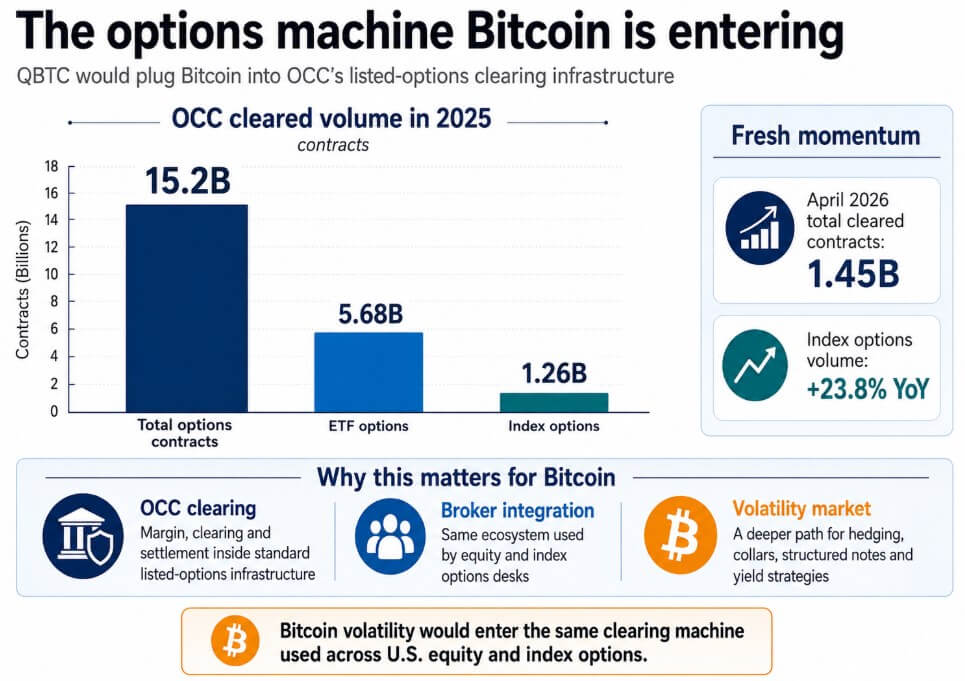
Bitcoin index options would enter OCC’s clearing machine, carrying all the margin treatment, brokerage integrations, and market maker relationships that infrastructure entails, placing Bitcoin volatility inside the same portfolio-margin systems and volatility desks equity indexes use.
Cboe already offers cash-settled Bitcoin index products, such as Bitcoin US ETF Index options and Mini Bitcoin US ETF Index options, European-style contracts based on an index of US-listed spot Bitcoin ETFs.
Nasdaq’s QBTC uses BRTI as its underlying asset, tying the contract’s value directly to Bitcoin’s spot price.
The SEC cited the spot Bitcoin market cap at approximately $1.52 trillion as of Apr. 29, and noted that proposed position and exercise limits would represent 0.12% of the outstanding Bitcoin supply.
These are limits that the SEC set to contain the product’s footprint relative to the underlying Bitcoin market while still allowing meaningful institutional scale.
Nasdaq PHLX can list and trade QBTC only once it receives CFTC exemptive relief, satisfies all related conditions, and OCC receives approval to update the Options Disclosure Document.
Whether those limits hold under stress, and whether the CFTC processes its exemptive relief on a timeline that allows 2026 trading, the approval itself leaves open.
The market maker test for QBTC options
If CFTC exemptive relief and OCC approval arrive and market makers deploy capital with tight spreads, Bitcoin gains a deep, liquid volatility surface inside equity options infrastructure, and banks and asset managers gain the toolkit to build collars, buffered notes, downside-protection strategies, and volatility-selling yield structures with BTC as the underlying.
One QBTC contract would represent roughly one Bitcoin of notional exposure at the $100 multiplier, and at Bitcoin around $76,593, 10,000 contracts would represent approximately $766 million of underlying notional.
Covered-call Bitcoin ETFs have already demonstrated that yield-generating structures built on BTC carry real retail and advisor demand. An exchange-listed index option gives those strategies a more credible clearing foundation and a cleaner underlying.
If the CFTC delays exemptive relief or attaches conditions that complicate Nasdaq’s product design, thin market maker participation becomes the chokepoint.
Wide spreads discourage institutional use, which keeps spreads wide, and the approval stays symbolic, while IBIT options and Cboe’s ETF-index options keep capturing the regulated Bitcoin options market.
QBTC enters that market, building its dealer and brokerage network from scratch, without the market maker familiarity IBIT options accumulated alongside ETF adoption.
| Scenario | What happens | Signal to watch | Bitcoin market impact |
|---|---|---|---|
| Bull case | CFTC/OCC approvals clear and market makers quote tight spreads | Strong opening volume, narrow bid-ask spreads, institutional flow | BTC gains a deeper listed volatility surface |
| Base case | QBTC launches but grows gradually beside IBIT options and Cboe ETF-index options | Moderate volume, ETF hedging use cases, gradual broker adoption | Incremental improvement in BTC risk-management tools |
| Bear case | CFTC relief is delayed or conditions complicate product design | No launch timeline, weak dealer commitment | Approval remains symbolic |
| Liquidity trap | Product launches, but spreads stay wide | Low open interest, thin depth, limited market-maker capital | Institutions keep using IBIT options or futures instead |
The SEC’s approval reflects that Bitcoin is a $1.52 trillion asset class, with spot ETFs, CME futures, ETF options, and a pending listed index options product calibrated to US market close mechanics.
Nasdaq Bitcoin index options show that Bitcoin’s next institutional phase runs through options clearinghouses, margin systems, and structured-product desks, and the SEC has now confirmed it is willing to let that integration proceed.