

For most of Web3’s history, launching a token meant relying on someone else’s platform.
Projects typically sent their communities to centralized launchpads or stitched together custom smart contracts under intense time pressure. While these models helped standardize fundraising during the early growth of the industry, they also created tradeoffs around ownership, user experience, and operational complexity.
A new category of infrastructure is now emerging to address those limitations. Instead of acting as marketplaces for token launches, these systems focus on enabling projects to run public sales directly within their own ecosystem while the infrastructure handles the mechanics behind the scenes.
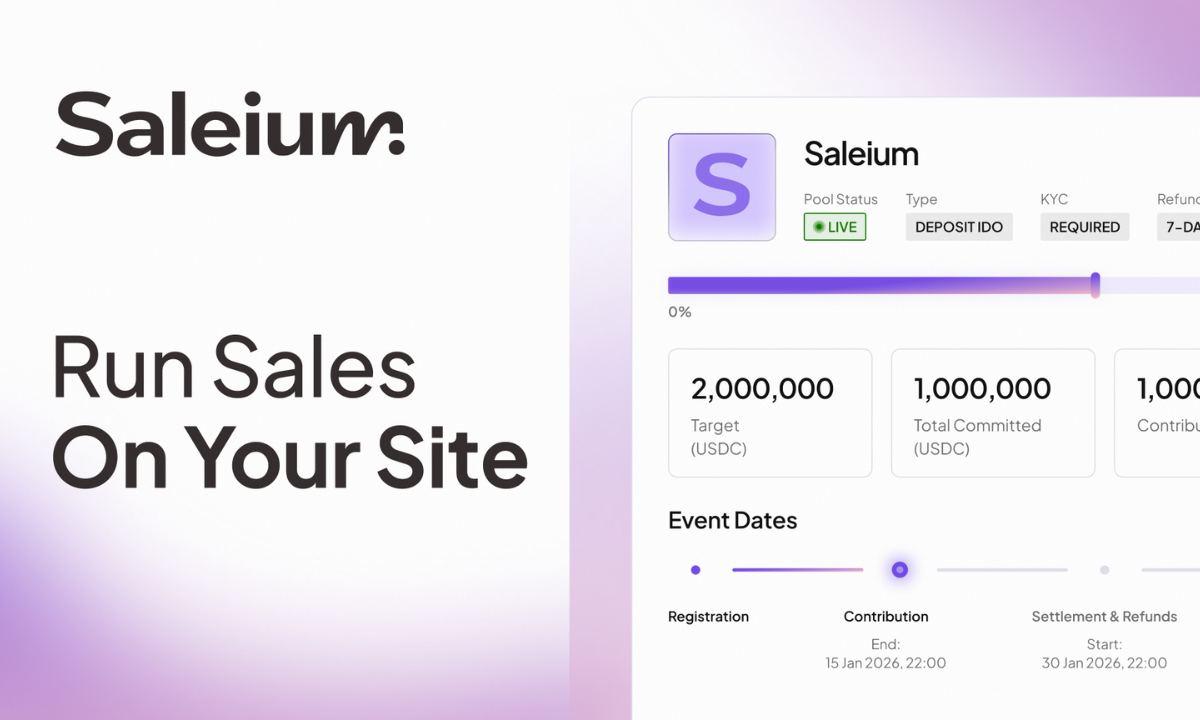
ChainGPT recently introduced Saleium, a platform designed to support this emerging model.
The Rise of Self-Hosted Token Sale Infrastructure
The idea behind self-hosted token sale infrastructure is straightforward. Rather than redirecting users to a third party launchpad, projects embed the sale directly on their own website while external infrastructure manages elements such as allocation logic, compliance checks, and settlement.
For founders, the appeal is largely about control.
Token launches are often the first major moment when a project interacts with thousands of participants simultaneously. Sending that activity to an external marketplace can fragment the experience and weaken the connection between a project and its community.
Infrastructure-first approaches attempt to solve that problem by keeping distribution closer to the project itself while still providing the technical systems needed to run a compliant and well structured sale.
Several companies are now exploring different approaches to this model.
A Growing Landscape of Launch Infrastructure
A number of projects are beginning to build infrastructure around this emerging category.
Echo’s Sonar focuses primarily on the identity and verification layer behind token sales. The platform allows participants to verify their identity once and reuse that verification across multiple offerings, with authorization permits used to manage eligibility and compliance.
Impossible Finance’s Curated takes a distribution focused approach. Rather than relying on a single launch interface, the platform aims to distribute token sales and investment opportunities across partner platforms, communities, and project websites.
On the protocol side, the Metaplex Foundation’s Genesis framework provides audited token launch primitives for the Solana ecosystem. Instead of hosting sales directly, Genesis offers smart contract mechanisms that projects can integrate into their own applications.
Meanwhile Tally, originally known for DAO governance infrastructure, has expanded into token lifecycle tooling that includes fundraising mechanisms alongside vesting, incentives, and governance systems.
Taken together, these approaches suggest the industry is gradually shifting away from launchpads as destinations and toward infrastructure that can be embedded directly into project ecosystems.
Where Saleium Fits
This is the context in which Saleium enters the market.
The platform is designed as a self-hosted public sale engine that allows teams to run token sales directly on their own website while the infrastructure manages the operational layer behind the scenes.
Projects integrate an embeddable sale widget into their site, while Saleium handles elements such as oversubscription management, pro rata allocation calculations, and automated refund processing. The system also includes post-sale flows such as token claims and vesting, along with an administrative dashboard that allows teams to manage the event.
Saleium supports multiple operational models. Teams can run sales fully self managed or choose a setup where the ChainGPT team assists with operational aspects of the launch.
Because the platform builds on infrastructure already used within the ChainGPT ecosystem, it enters the market with an existing operational foundation and experience running large token launches.
Token Launches Are Becoming Infrastructure
The broader trend behind these developments is that token launches are increasingly being treated as infrastructure rather than one time events.
Instead of relying on a single platform to host distribution, projects now have access to systems that allow them to run launches within their own ecosystem while still benefiting from standardized compliance and settlement tools.
Different companies are approaching the problem from different angles. Some focus on identity and verification layers, while others provide smart contract frameworks or distribution networks.
Saleium represents another step in that evolution by focusing on self-hosted sale infrastructure designed to run directly inside a project’s own environment.
As token launches continue to mature, the tools that power them are starting to resemble the broader Web3 stack itself. Less marketplace, more infrastructure.

Kosta joined the team in 2021 and quickly established himself with his thirst for knowledge, incredible dedication, and analytical thinking. He not only covers a wide range of current topics, but also writes excellent reviews, PR articles, and educational materials. His articles are also quoted by other news agencies.