

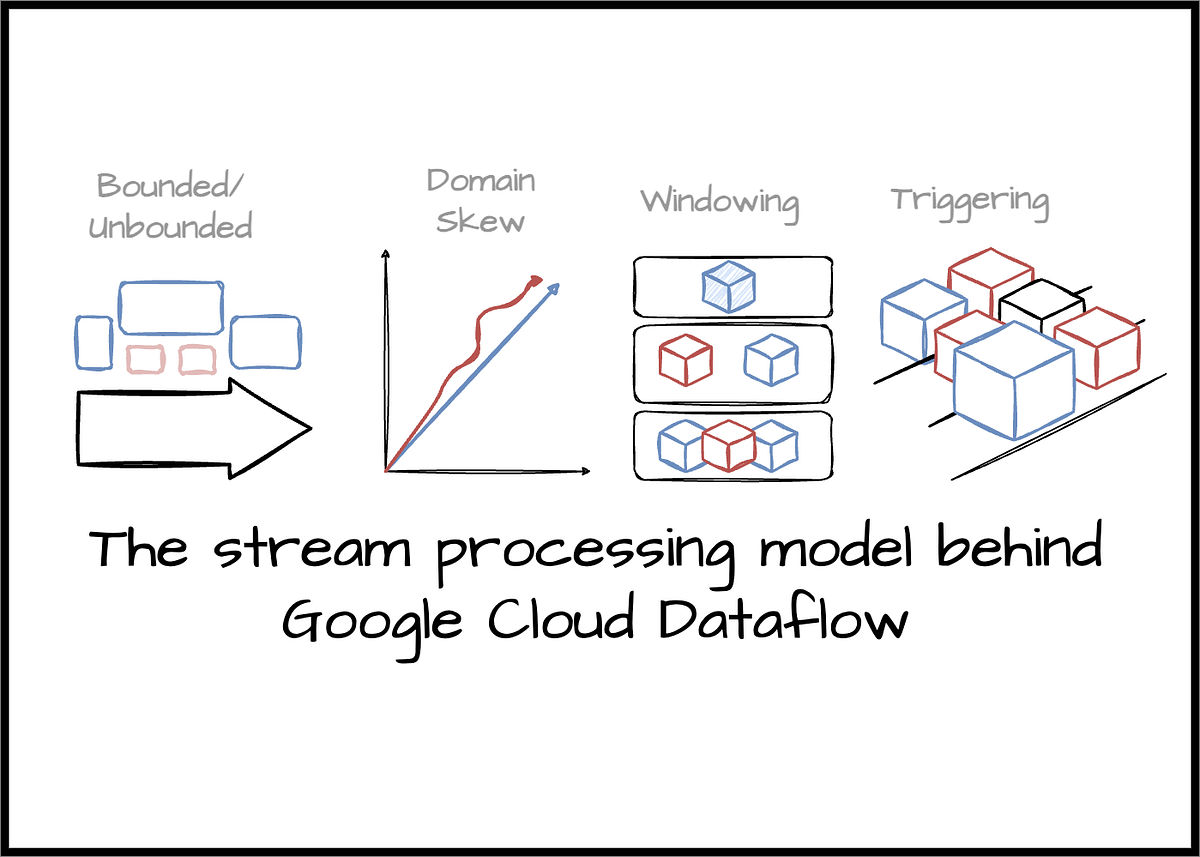
At the time of the paper writing, data processing frameworks like MapReduce and its “cousins “ like Hadoop, Pig, Hive, or Spark allow the data consumer to process batch data at scale. On the stream processing side, tools like MillWheel, Spark Streaming, or Storm came to support the user. Still, these existing models did not satisfy the requirement in some common use cases.
Consider an example: A streaming video provider’s business revenue comes from billing advertisers for the amount of advertising watched on their content. They want to know how much to bill each advertiser daily and aggregate statistics about the videos and ads. Moreover, they want to run offline experiments over large amounts of historical data. They want to know how often and for how long their videos are being watched, with which content/ads, and by which demographic groups. All the information must be available quickly to adjust their business in near real-time. The processing system must also be simple and flexible to adapt to the business’s complexity. They also require a system that can handle global-scale data since the Internet allows companies to reach more customers than ever. Here are some observations from people at Google about the state of the data processing systems of that time:
- Batch systems such as MapReduce, FlumeJava (internal Google technology), and Spark fail to ensure the latency SLA since they require waiting for all data input to fit into a batch before processing it.
- Streaming processing systems that provide scalability and fault tolerance fall short of the expressiveness or correctness aspect.
- Many cannot provide exactly once semantics, impacting correctness.
- Others lack the primitives necessary for windowing or provide windowing semantics that are limited to tuple- or processing-time-based windows (e.g., Spark Streaming)
- Most that provide event-time-based windowing rely on ordering or have limited window triggering.
- MillWheel and Spark Streaming are sufficiently scalable, fault-tolerant, and low-latency but lack high-level programming models.
They conclude the major weakness of all the models and systems mentioned above is the assumption that the unbounded input data will eventually be complete. This approach does not make sense anymore when faced with the realities of today’s enormous, highly disordered data. They also believe that any approach to solving diverse real-time workloads must provide simple but powerful interfaces for balancing the correctness, latency, and cost based on specific use cases. From that perspective, the paper has the following conceptual contribution to the unified stream processing model:
- Allowing for calculating event-time ordered (when the event happened) results over an unbounded, unordered data source with configurable combinations of correctness, latency, and cost attributes.
- Separating pipeline implementation across four related dimensions:
– What results are being computed?
– Where in event time they are being computed.
– When they are materialized during processing time,
– How do earlier results relate to later refinements?
- Separating the logical abstraction of data processing from the underlying physical implementation layer allows users to choose the processing engine.
In the rest of this blog, we will see how Google enables this contribution. One last thing before we move to the next section: Google noted that there is “nothing magical about this model. “ The model doesn’t make your expensive-computed task suddenly run faster; it provides a general framework that allows for the simple expression of parallel computation, which is not tied to any specific execution engine like Spark or Flink.

The paper’s authors use the term unbounded/bounded to define infinite/finite data. They avoid using streaming/batch terms because they usually imply using a specific execution engine. The term unbound data describes the data that doesn’t have a predefined boundary, e.g., the user interaction events of an active e-commerce application; the data stream only stops when the application is inactive. Whereas bounded data refers to data that can be defined by clear start and end boundaries, e.g., daily data export from the operation database.