

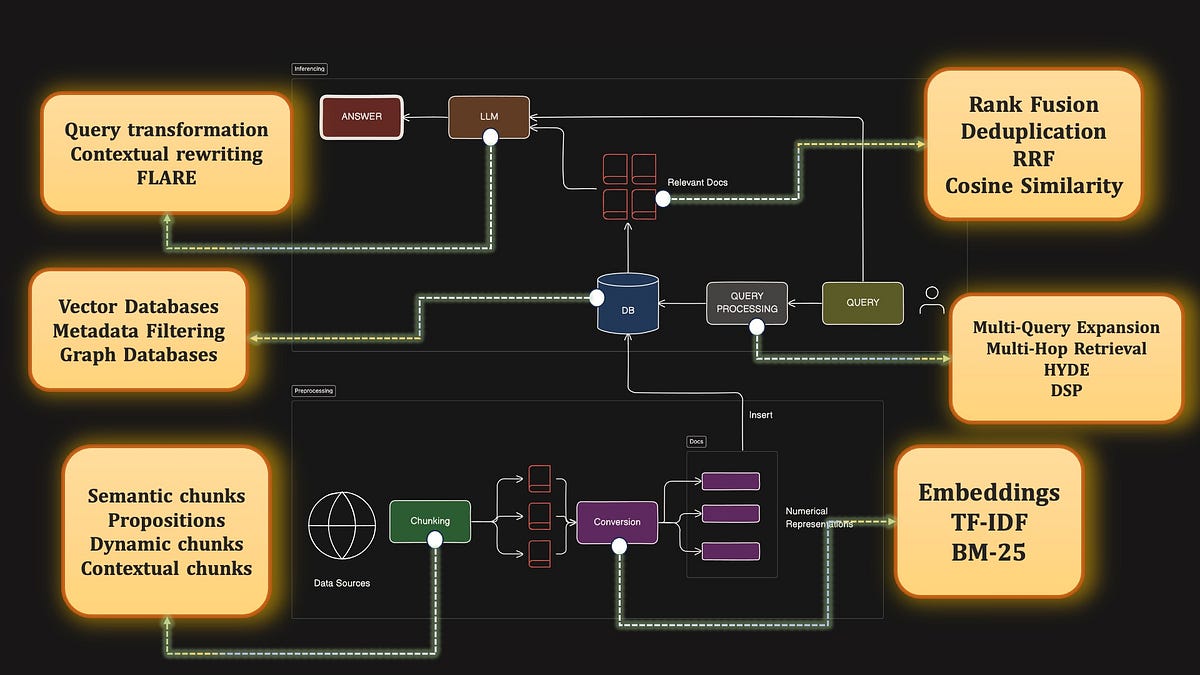
Next, we come to the data-conversion stage. Note that whatever strategy we used to convert the documents during preprocessing, we need to use it to search for similarity later, so these two components are tightly coupled.
Two of the most common approaches that have emerged in this space are embedding based methods and keyword-frequency based methods like TF-IDF or BM-25.
Embedding Based Methods
We’ll start with embedding-based methods. Here, we use pretrained transformer models to transform the text into high-dimensional vector representations, capturing semantic meaning about the text. Embeddings are great for capturing semantic relationships, handling synonyms, and understanding context-dependent meanings. However, embedding can be computationally intensive, and can sometimes overlook exact matches that simpler methods would easily catch.

When does Semantic Search fail?
For example, suppose you have a database of manuals containing information about specific refrigerators. When you ask a query mentioning a very specific niche model or a serial number, embeddings will fetch documents that kind of resemble your query, but may fail to exactly match it. This brings us to the alternative of embeddings retrieval — keyword based retrieval.
Keyword Based Methods
Two popular keyword-based methods are TF-IDF and BM25. These algorithms focus on statistical relationships between terms in documents and queries.
TF-IDF weighs the importance of a word based on its frequency in a document relative to its frequency in the entire corpus. Every document in our dataset is be represented by a array of TF-IDF scores for each word in the vocabulary. The indices of the high values in this document vector tell us which words that are likely to be most characteristic of that document’s content, because these words appear more frequently in this document and less frequently in others. For example, the documents related to this Godrej A241gX , will have a high TF-IDF score for the phrase Godrej and A241gX, making it more likely for us to retrieve this using TF-IDF.

BM25, an evolution of TF-IDF, incorporates document length normalization and term saturation. Meaning that it adjusts the TF-IDF score based on if the document itself is longer or shorter than the average document length in the collection. Term saturation means that as a particular word appears too often in the database, it’s importance decreases.
TF-IDF and BM-25 are great finding documents with specific keyword occurrences when they exactly occur. And embeddings are great for finding documents with similar semantic meaning.
A common thing these days is to retrieve using both keyword and embedding based methods, and combine them, giving us the best of both worlds. Later on when we discuss Reciprocal Rank Fusion and Deduplication, we will look into how to combine these different retrieval methods.