


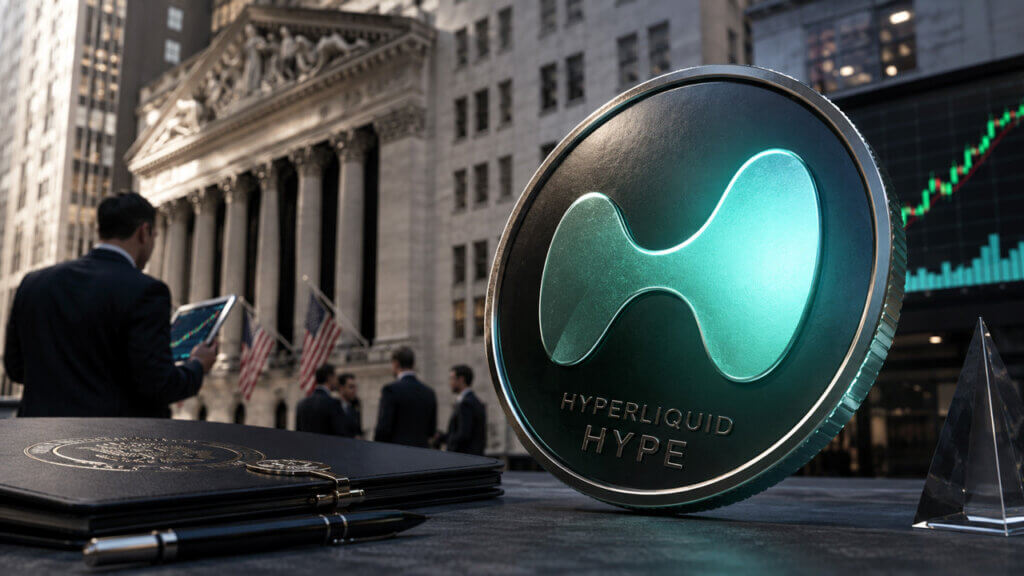
Options on Bitwise’s HYPE ETF give Wall Street a regulated venue to price risk on a 24/7, perpetual futures exchange that trades only during US market hours.
BHYP began trading on the NYSE on May 15, holding spot HYPE with in-house staking built into the fund. Options on those shares now also trade, connecting four markets that have never shared a settlement rail before: NYSE-listed ETF shares, US-listed options, HYPE spot and perpetual futures, and Hyperliquid’s on-chain trading economy.
A venue token’s price tells a different story
DeFiLlama shows the protocol processing roughly $244 billion in 30-day perpetual trading volume against more than $9.6 billion in open interest. These figures place Hyperliquid’s trading activity closer to that of a derivatives exchange than to that of a typical layer-1 network.
Bitwise says the protocol handled $2.9 trillion in trading volume across 2025 and commands about 60% of on-chain derivatives open interest, processing roughly 200,000 orders per second.
Hyperliquid routes 99% of net protocol fees into an Assistance Fund that buys HYPE on the open market, a buyback governed by protocol policy that carries no contractual guarantee.
| Metric / feature | Figure or mechanism | Why it matters |
|---|---|---|
| 30-day perp volume | ~$244B | Shows Hyperliquid is being valued around trading activity, not just chain adoption. |
| Open interest | ~$9.6B | Indicates deep derivatives-market usage and trader positioning. |
| 2025 trading volume | ~$2.9T | Supports the comparison to a derivatives exchange. |
| Onchain derivatives open interest share | ~60% | Shows market-share dominance in its category. |
| Processing capacity | ~200,000 orders/sec | Reinforces the exchange-infrastructure framing. |
| Fee routing | 99% of net protocol fees to Assistance Fund | Links HYPE’s narrative to trading fees and buyback pressure. |
HYPE’s price already moves with that revenue and volume story, which is what listed options now let traders isolate and trade directly.
A trader who wants leveraged upside without HYPE’s full downside can buy BHYP calls, turning a directional bet on HYPE into a convex bet on Hyperliquid’s trading volume and fee growth.
Advisors managing existing HYPE exposure get a different tool via selling covered calls against BHYP holdings, stacking option premium on top of the staking yield already running inside the fund, which Bitwise lists at a 2.25% gross reward rate and 1.18% net as of June 16, with about 70% of fund assets currently staked.
The holder still carries full downside on HYPE and gives up upside above the strike, so the premium pays for capped upside while the underlying risk stays exactly where it was.
A fund that wants to hold HYPE through volatility while limiting exposure to a severe drawdown can buy protection directly, or reduce the hedge’s cost by selling a call against a purchased put.
That gives a risk committee the ability to define and bound HYPE’s risk in advance, before taking the position at all.
The hours mismatch that defines the trade
BHYP options settle only during US-listed options hours, while HYPE itself trades continuously, every hour of every day, on crypto-native spot and perpetual markets.
Bitwise’s SEC filing for the fund shows that non-concurrent trading hours between US equity markets and the 24-hour HYPE market can cause BHYP to gap at the open and trade at a premium or discount to net asset value.
That mismatch creates a distinct risk window between Friday’s options close and Monday’s open. A trader can buy BHYP calls or puts heading into a weekend specifically to express a view on what HYPE might do while American markets sit closed.
A market maker who sold those options carries the resulting exposure through the weekend and may need to hedge it using HYPE spot or perpetual futures on crypto-native venues, since the ETF itself isn’t there to hedge against until Monday.
Wall Street ends up pricing HYPE’s risk during business hours while crypto-native markets absorb and transmit that same risk overnight, a division of labor that BHYP’s options chain created on its own.
| Market layer | Trading window | Role in the BHYP options trade |
|---|---|---|
| BHYP ETF shares | U.S. equity market hours | Main regulated wrapper for HYPE exposure. |
| BHYP options | U.S. listed-options hours | Lets traders buy calls, buy puts, sell covered calls, or build collars. |
| HYPE spot markets | 24/7 | Can be used to hedge exposure when BHYP is closed. |
| HYPE perpetuals | 24/7 | Likely hedge venue for market makers managing weekend or overnight risk. |
| Hyperliquid protocol | 24/7 | Underlying economic engine driving volume, fees, and HYPE narrative. |
Dealer hedging could feed back into HYPE itself
A standard equity options contract controls 100 underlying shares, and Bitwise reports 0.561095 HYPE backing each BHYP share, putting roughly 56 HYPE behind a single options contract before accounting for future changes in fund holdings, fees, or staking distributions.
Scaling that across open interest on 50,000 contracts would reference roughly 2.8 million HYPE, north of $200 million in notional terms at recent prices.
When traders buy calls in size, dealers who sold those calls typically hedge by buying the underlying, here BHYP shares, which can pull the ETF away from its net asset value and trigger creation or redemption activity that eventually connects back to HYPE itself.
Put buying can pull the same lever in the opposite direction, with dealers hedging short-put exposure by selling BHYP shares instead.
The size of that effect depends entirely on how large open interest grows relative to BHYP’s own liquidity and HYPE’s spot and perpetual market depth, and on whether dealers choose to hedge with BHYP shares, HYPE spot, or HYPE perpetuals.
What the mechanism guarantees is a new channel connecting listed options flow to a token whose only prior derivatives exposure ran through unregulated crypto-native venues.
Bitwise’s own filing warns that staked HYPE locked inside an unstaking queue could limit the fund’s ability to meet redemption requests promptly. This constraint could widen BHYP’s spread or push the ETF further from its underlying value during stressed periods, exactly when options-driven hedging activity tends to spike.
How this resolves
Options volume and open interest on BHYP build steadily as more advisors discover the covered-call income angle and more directional traders move from spot HYPE into leveraged calls.
Market makers hedge actively across BHYP shares, HYPE spot, and HYPE perpetuals, tightening the connection between Wall Street’s options desks and crypto-native liquidity.
HYPE gains a real, visible volatility surface that institutional desks can study, trade, and use to price tail risk through put skew. ETF liquidity deepens alongside that activity, and the feedback loop between options flow and HYPE price discovery moves from a theoretical possibility into a two-way market-structure feature.
A Hyperliquid-specific shock, a volume slowdown, a regulatory scare, an exchange outage, or a sharp HYPE drawdown sends put demand sharply higher relative to calls, and the options chain settles into a one-sided risk-management product with little speculative balance left.
Wide bid-ask spreads on BHYP options discourage volatility arbitrage that would otherwise tighten the link between ETF pricing and HYPE’s underlying markets.
A weekend price move while BHYP sits closed forces the ETF to gap sharply at Monday’s open, and the conversation around staking liquidity, redemption timing, and NAV premiums comes to dominate coverage that launched on a bullish options-flow narrative.
| Scenario | What happens | What traders do | What it means for Wall Street |
|---|---|---|---|
| Bull case | Options volume and open interest grow steadily; hedging links BHYP, HYPE spot, and HYPE perps. | Buy calls, sell covered calls, trade volatility, hedge with perps. | HYPE develops a visible listed-volatility surface and becomes easier for institutions to trade. |
| Base case | Liquidity builds slowly; options are useful but remain a niche product. | Advisors use covered calls and collars; retail buys calls selectively. | BHYP becomes a regulated access point, but feedback into HYPE remains limited. |
| Bear case | A HYPE drawdown, outage, regulatory scare, or liquidity stress makes puts expensive and markets one-sided. | Traders buy protection; dealers widen spreads; volatility arbitrage weakens. | BHYP options become a fear gauge rather than a growth engine. |
Whichever case plays out, the consequences extend well beyond a single fund’s options listing.
Wall Street now has a regulated, hours-bound venue for pricing risk on a token whose value depends on a derivatives exchange that never closes, and the bridge connecting those two worlds runs directly through dealer hedging, creation, and redemption flows that most equity options traders have never had to think about before.