


XRP rallied more than 10% on ceasefire optimism, but whales positioned early, sold the $1.50 top, and stepped back. Retail is holding the floor for now.
Key Takeaways
- XRP rallied 13% during ceasefire negotiations, peaked at $1.50 on April 17.
- Whales moved coins to Binance from April 11 – before the opening, not after.
- Whale transactions near zero since – distribution likely complete.
- Retail inflows consistent throughout, holding the floor.
- Exchange reserves ticked up modestly then flattened.
- RSI at 53.74 – momentum cooled, structure intact.
Since February 28, when the US and Israel struck Iran, the Strait of Hormuz has been a revolving door of threats, partial openings, reversals, and ultimatums. Trump gave Iran deadlines. Iran let China and India through. The April 7 ceasefire changed almost nothing in practice. The Islamabad talks collapsed. The US imposed a full naval blockade on Iranian ports on April 13. Markets had been whipsawing on every headline for a month and a half, not waiting for relief, just repricing chaos in real time.
It was in that environment that XRP climbed 13%, from $1.32 on April 13 to $1.50 on April 17. Then Iran declared the strait open for all commercial vessels, tied to a fresh Israel-Lebanon ceasefire. Then on April 18, the IRGC closed it again. XRP pulled back to $1.43.
The on-chain data tells you exactly who saw all of this coming.
Whales Didn’t React to the News
The whale to exchange transactions chart from CryptoQuant is where this story really starts, and the timing changes everything.
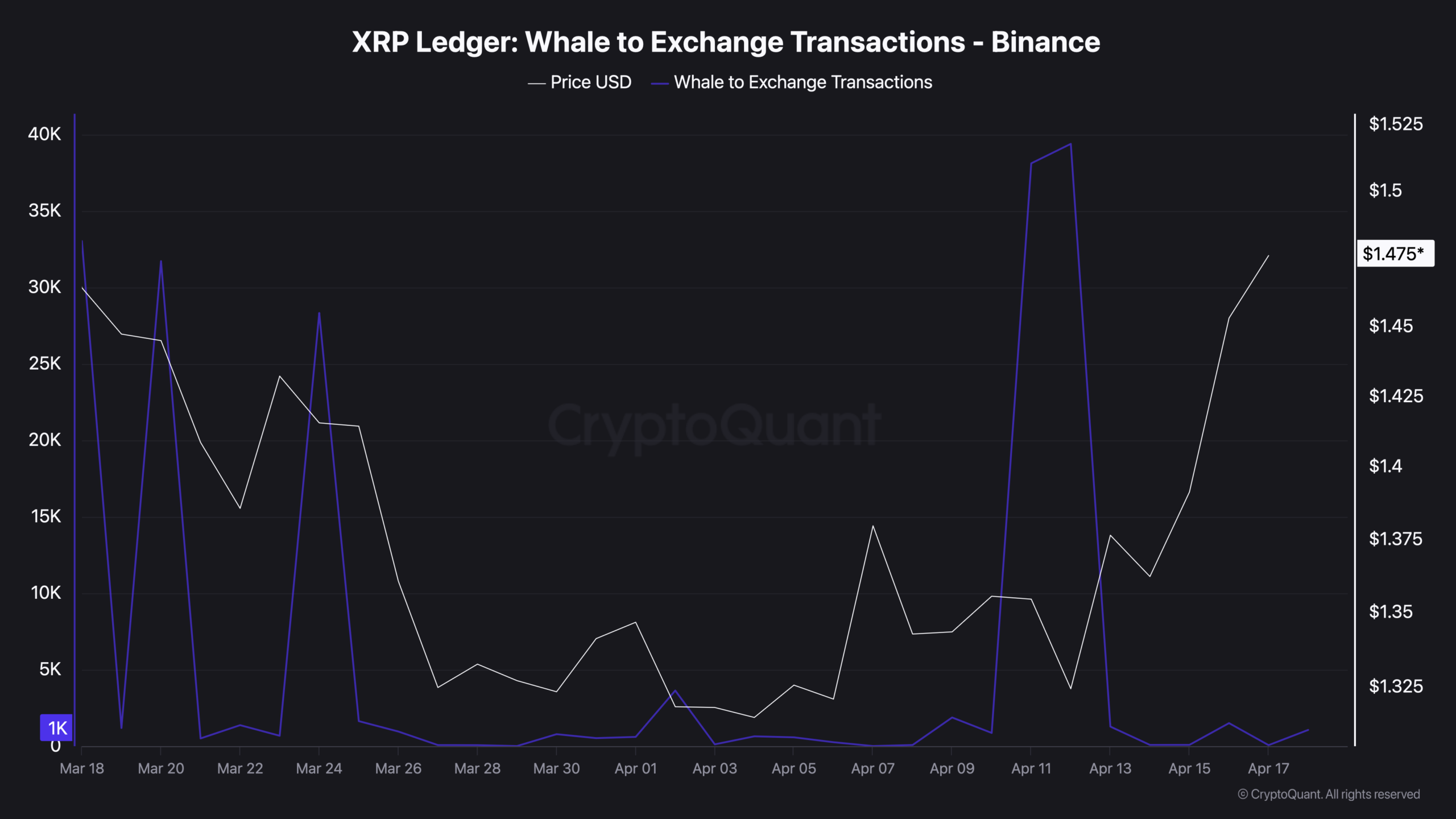
From late March through early April, large wallet movements to Binance were nearly invisible. Flatlined. Then around April 11, as the failed Islamabad talks triggered the US naval blockade and ceasefire negotiations quietly resumed behind closed doors — whale transactions exploded to nearly 39,000 in a single day. The highest reading on the entire chart. Six days before Iran declared the strait open.
These were not traders reacting to good news. They were already positioned. They read the diplomatic signals early, moved coins to Binance while price was still building momentum, and sold into the retail wave that followed when the ceasefire headlines finally dropped. By April 17, when the strait opened and everyone else was buying, they were already done selling.
By April 18, whale transactions had collapsed back to near zero.
The Reserves Tell the Same Story
XRP exchange reserves on Binance had been falling steadily since mid-March, dropping from 2.8B to 2.74B by early April. Coins leaving exchanges, less sell pressure available, a clean bullish signal going into the rally.
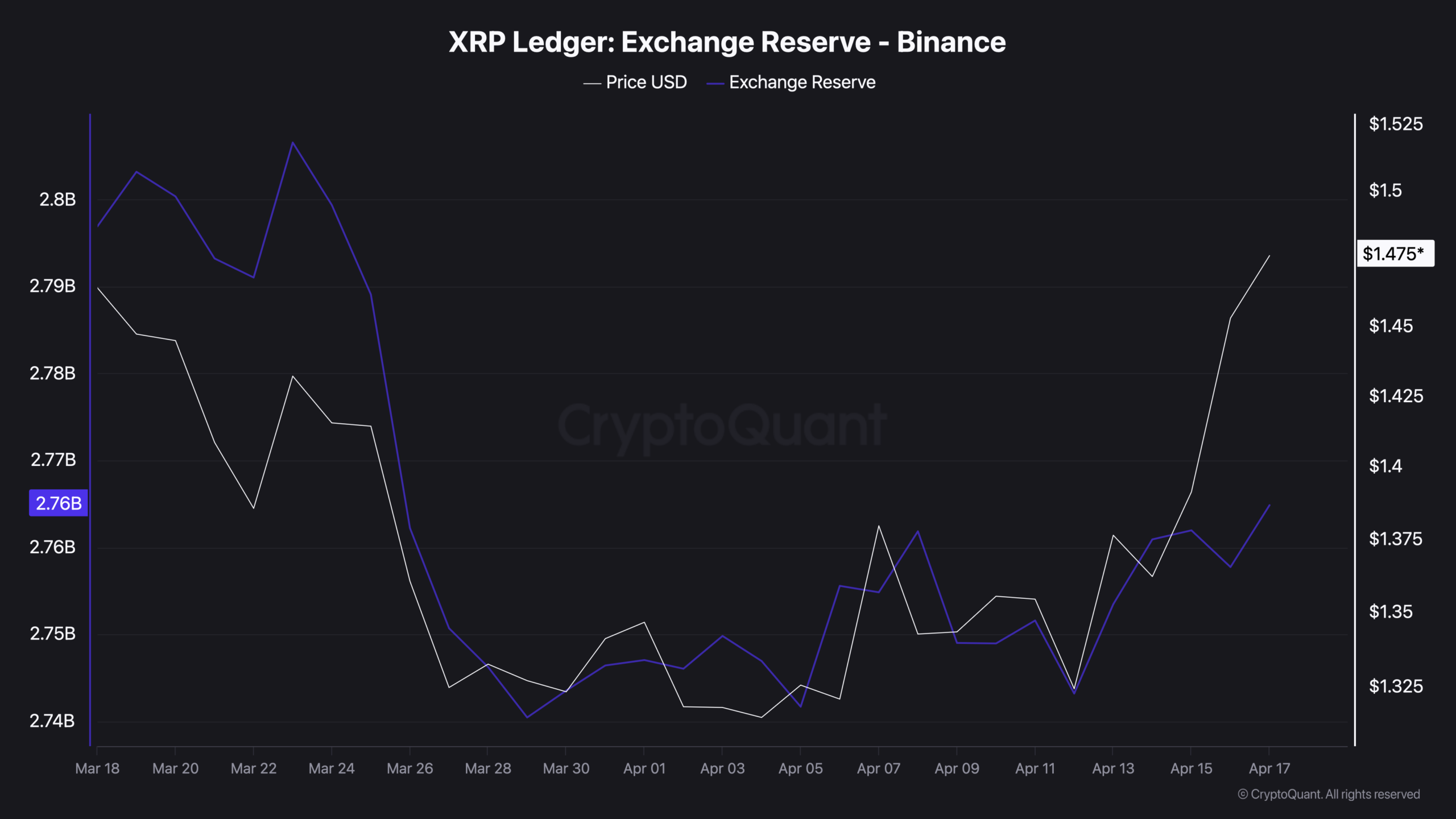
Then from April 15, reserves started climbing again toward 2.76B, moving in lockstep with the whale activity. The two datasets point at the same thing from different angles: coins going back onto the exchange, price approaching its ceiling, distribution happening in plain sight.
But here is the detail that matters. The reserve increase stopped. Around 20 million XRP returned to Binance and the flow flattened. A sustained sell-off would look like reserves continuing to climb aggressively. They didn’t. Which means the whales most likely took what they came for and stepped back – not setting up for a second wave down.
Retail Never Left But It Has a Ceiling
While whales were exiting at $1.50, retail kept showing up without drama. The inflow transactions chart by value band shows consistent small-wallet activity throughout, under 1K XRP dominating the entire period. No panic, no mass exit, even as price pulled back from the top.
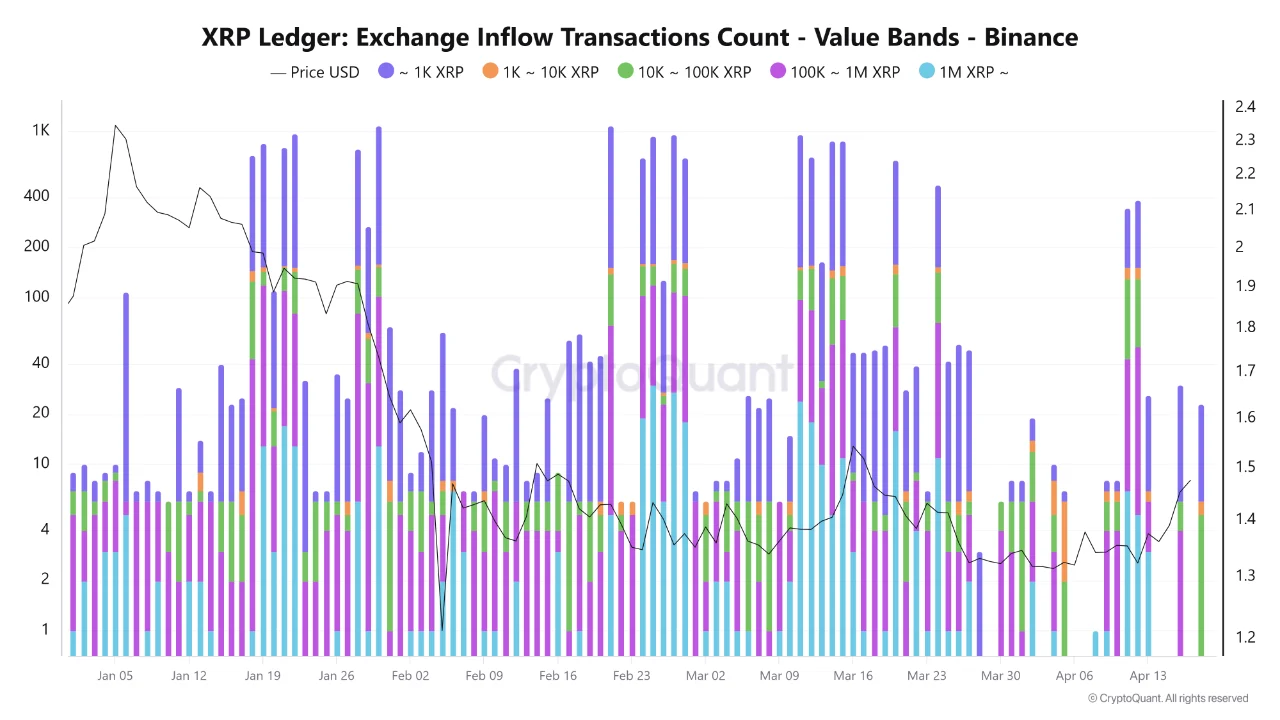
What makes this interesting is that these retail inflows are not pushing price lower. Coins coming in at this size are being absorbed by liquidity on the other side without much resistance. The floor is broad and distributed, which is stickier than support held up by one or two large players who can disappear overnight.
The catch is simple. Retail maintains the floor but cannot build a new ceiling. Pushing XRP convincingly through $1.50 and holding it requires large buyers returning with real conviction. Right now, having just taken profits into that exact level, they are watching.
The Price Chart: Catching Its Breath
On the 4-hour chart, the move from $1.50 back to $1.43 looks controlled. No flush, no panic candles, no volume spike on the downside, just a measured step lower as the brief optimism faded and the Hormuz loop restarted for the seventh time.
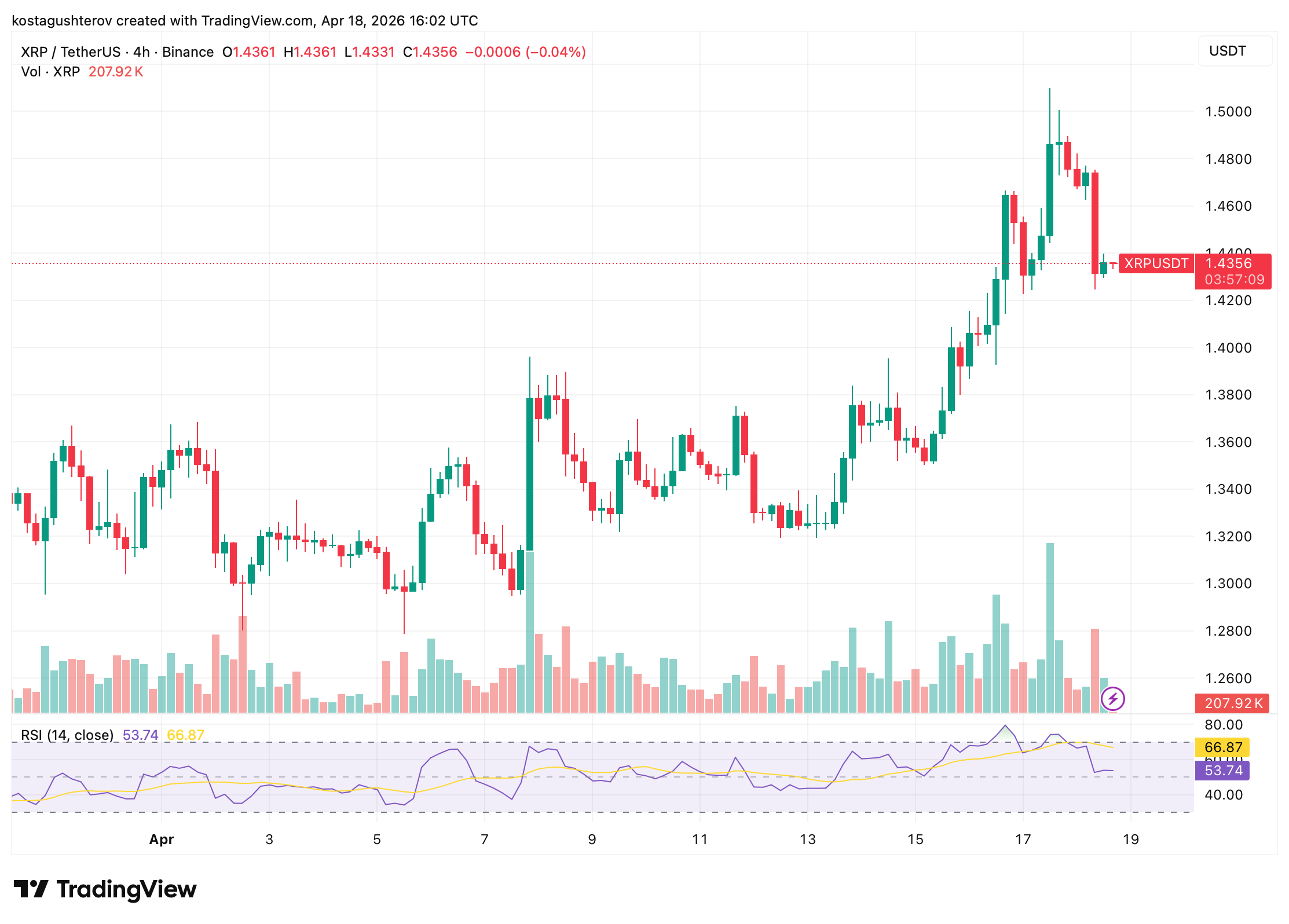
RSI sits at 53.74, well below the signal line at 66.87. Momentum has cooled but nothing has broken. $1.43 is the line that matters now, it was the consolidation base before the April 15 push and it is exactly where price landed after the distribution. Buyers holding it here keeps the higher timeframe structure clean. Losing it puts $1.37 on the table, which was XRP’s range before any of the ceasefire optimism started moving markets.
Where This Goes From Here
After seven weeks of the same loop, markets have got better at this. The full panic of early March is gone. What replaced it is a market that rallies on ceasefire signals, gets sold by people who positioned early, pulls back to support, and waits. XRP’s move from $1.32 to $1.50 was not irrational – it was exactly how a market prices improving odds in a situation that has been binary for weeks.
The whale data is the most important signal for what comes next. They distributed at $1.50, stepped back, and have not pressed the downside. That is not the behaviour of a market rolling over – that is profit-taking at resistance, which is completely normal. The supply overhead that capped the first attempt at $1.50 is now lighter.
If the US-Iran talks produce any credible signal of progress, XRP retests $1.50 in better shape than the first time – less whale supply sitting above it, retail already holding the base, RSI with room to build again.
If talks collapse and macro sentiment deteriorates, $1.37 breaks and this becomes a broader market story rather than an XRP one.
The structure says another attempt at $1.50 is more likely than a breakdown from here. The next move is the macro’s call to make.
The information provided in this article is for educational purposes only and does not constitute financial, investment, or trading advice. Coindoo.com does not endorse or recommend any specific investment strategy or cryptocurrency. Always conduct your own research and consult with a licensed financial advisor before making any investment decisions.

Kosta joined the team in 2021 and quickly established himself with his thirst for knowledge, incredible dedication, and analytical thinking. He not only covers a wide range of current topics, but also writes excellent reviews, PR articles, and educational materials. His articles are also quoted by other news agencies.