


Bitcoin miners have collectively sold over 15,000 BTC from their treasuries in recent months, redirected capital into AI data centers, and pushed network hashrate down more than 20% from its October 2025 peak.
Key Takeaways
- Miner selling pressure retreats to 2024 lows despite structural pivot.
- MARA sells 15,133 BTC in three weeks to fund AI buildout.
- Average production cost reaches $79,995 per BTC mined.
- Over $70B in AI contracts announced across public mining sector.
- Bitcoin network hashrate falls from 1,160 to 920 EH/s.
The Miners Position Index 30-day moving average has simultaneously retreated to its lowest level since 2024. The structural liquidation is real. The immediate on-chain selling pressure has cooled to near its lowest point in two years. Both are true at the same time, and understanding why explains more about where Bitcoin’s supply pressure actually comes from than the headline numbers suggest.
Why the Economics Forced the Decision
CoinShares’ Q1 2026 mining report puts the weighted average cash cost to produce one Bitcoin among publicly listed miners at approximately $79,995 in Q4 2025. Bitcoin has been trading between $67,000 and $70,000. The implied loss per coin mined sits between $10,000 and $14,000 at current prices. That is not a marginal squeeze. It is a structural problem.
Hash price, the metric determining miner revenue per unit of computing power, declined from approximately $63 per petahash per day in July 2025 to a five-year low of $35–37 by November, before collapsing further into Q1 2026. According to James Butterfill, Head of Research at CoinShares, hash price briefly touched $28 per petahash per day in late February before recovering to approximately $30–35 at the time of the report, an all-time post-halving low. At that level, any miner operating below the efficiency of an S19 XP at electricity costs above $0.06 per kilowatt-hour is losing money. CoinShares estimates that represents approximately 15–20% of the global mining fleet.
Traditional mining costs approximately $700,000 to $1 million per megawatt to build. AI-ready facilities require $8 million to $15 million per megawatt, driven by liquid cooling requirements and high-density power systems for current-generation GPU hardware. Ten times the capital requirement, and margins above 85% with multi-year revenue visibility on the other side of it, against losses for most miners at current Bitcoin prices.
MARA converted that gap into the most aggressive strategic pivot in the sector.
MARA’s Pivot in Detail
Between March 4 and March 25, MARA sold 15,133 BTC, roughly 28% of its entire treasury, generating approximately $1.1 billion in proceeds. The company used $1 billion of that to repurchase its own convertible debt at a 9% discount to par, saving $88.1 million in future obligations and cutting total convertible debt from $3.3 billion to $2.3 billion in a single move.
MARA CEO Fred Thiel confirmed the company will continue selling Bitcoin assets from time to time to fund its expansion into digital energy and AI infrastructure. The company retains 38,689 BTC after the March sales.
The same calculation has been running at every other major public miner simultaneously.
The Broader Liquidation Across the Sector
Core Scientific sold approximately 1,900 BTC in January 2026 for $175 million, and has announced plans to monetise substantially all of its remaining holdings throughout 2026 to fund its AI colocation strategy. AI revenue already accounts for 39% of Core Scientific’s total revenue. Bitdeer reduced its Bitcoin treasury to zero entirely. No partial reduction, zero.
Riot Platforms sold 1,818 BTC in December 2025 for $161.6 million, then separately liquidated 1,080 BTC to fund a 200-acre land acquisition for AI-ready campus development. Cipher Digital divested a 49% stake in mining joint ventures for $40 million and reduced its treasury from 2,284 BTC to 1,500 BTC as it redirects capital toward high-performance computing.
Collectively, publicly listed miners have reduced their BTC treasuries by over 15,000 BTC from peak levels, according to CoinShares. Miners with secured HPC contracts now trade at 12.3 times next-twelve-month sales against 5.9 times for pure-play Bitcoin miners, the valuation gap that makes every additional AI contract self-reinforcing.
That capital reallocation has a direct consequence for the network securing Bitcoin.
What This Means for the Network
Every dollar moving toward AI data centers is a dollar moving away from hashrate. Bitcoin’s network hashrate peaked at approximately 1,160 exahashes per second in early October 2025 and has since declined to roughly 920 EH/s, a drop of more than 20%, registering three consecutive negative difficulty adjustments, the first such streak since July 2022.
CoinShares forecasts the network hashrate reaching 1.8 zetahashes by end of 2026 and 2 zetahashes by end of March 2027, contingent on Bitcoin recovering to $100,000 by year-end. If prices remain below $80,000, hash price continues falling and more miners exit. A sustained move below $70,000 could trigger larger capitulation that paradoxically benefits survivors through lower difficulty.
The structural selling trend is clear and accelerating. What the on-chain data shows about immediate selling pressure tells a different story.
What the MPI Data Says About Today
The Miners Position Index measures the ratio of total miner outflow to its one-year moving average. An elevated reading signals miners sending more coins to exchanges than their historical average, overhead selling pressure in the near term. A suppressed reading means miners are moving fewer coins than usual, reducing immediate supply pressure on price.
According to CryptoQuant data, the MPI 30-day moving average has recently retreated to levels comparable to the 2024 lows. Despite the scale of the structural liquidations documented above, miners are currently moving fewer coins to exchanges than at almost any point in the past two years.
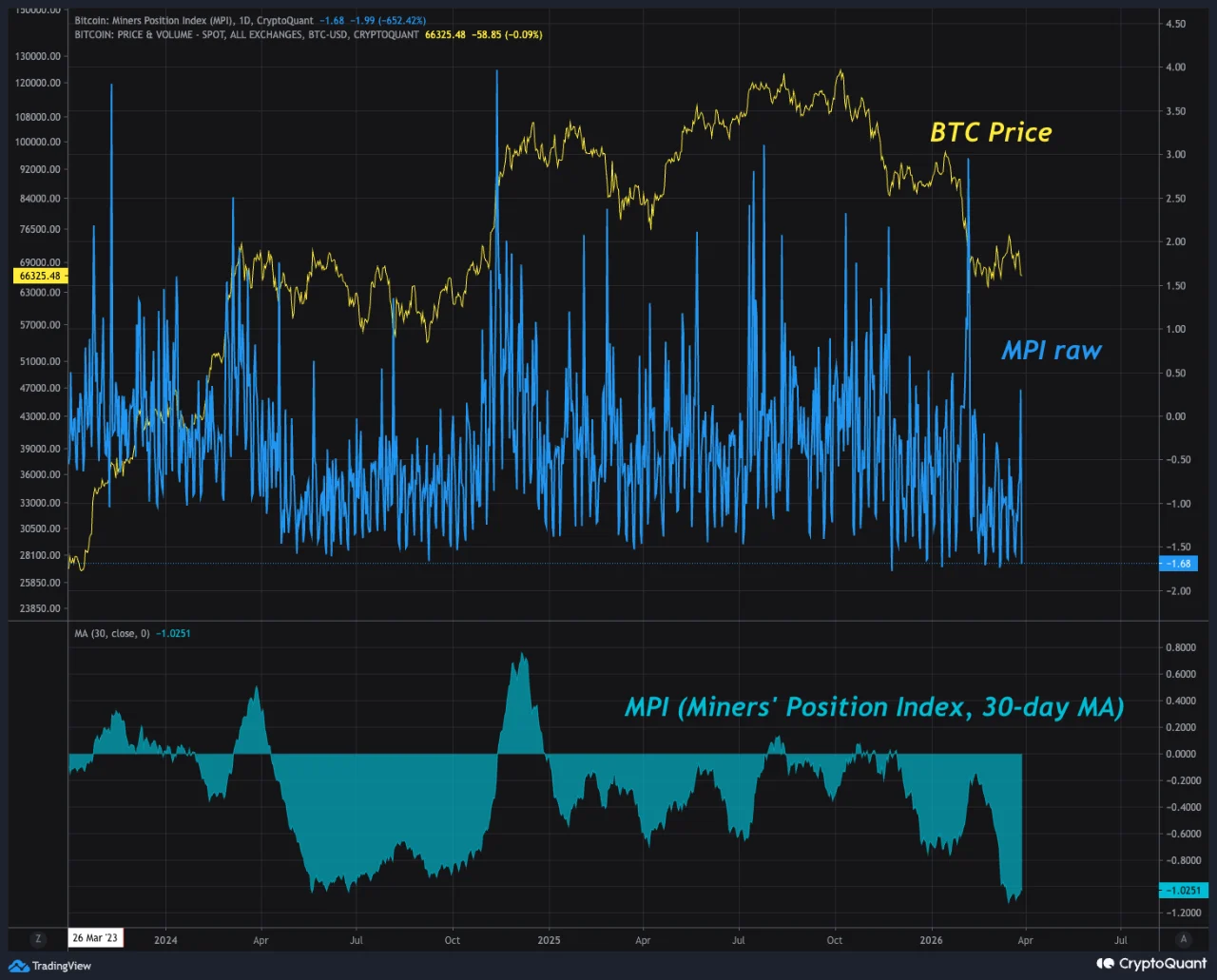
The resolution is in the timing. The large treasury liquidations, MARA’s 15,133 BTC, Core Scientific’s ongoing sales, Bitdeer’s complete dump, were strategic one-time moves that have already cleared through the market. What remains is the day-to-day operational outflow from active mining, and that flow has cooled significantly. The miners who were going to sell have largely sold. Immediate overhead supply from the sector has diminished as a result.
The structural pivot continues. Hashrate is still declining. AI contracts are still being signed. The long-term selling pressure from miners converting treasuries into AI capital remains a defining feature of this cycle. The MPI at 2024 lows measures something narrower and more immediate, the coins moving to exchanges right now, and by that measure, the mining sector is generating less selling pressure on Bitcoin’s price than it has in two years.
The One Variable That Decides the Outcome
The Bitcoin mining industry entered this cycle as a group of companies that secured the network and accumulated Bitcoin. It is exiting as a group that builds AI data centers and uses Bitcoin as the capital that funds them.
Bitdeer’s treasury is at zero. Core Scientific is selling substantially all remaining holdings. MARA sold 28% of its stack in three weeks. The structural direction is not ambiguous.
What the MPI data adds to that picture is a specific near-term nuance. The miners who were going to sell have largely sold. Day-to-day operational outflow has cooled to 2024 lows. The immediate overhead supply pressure from the mining sector on Bitcoin’s price is near its lowest point in two years, not because the pivot has slowed, but because the largest one-time liquidations have already cleared through the market.
Two things are true simultaneously. The structural selling is real, ongoing, and tied to economics that have not changed at $67,000. The near-term selling pressure from miners is at a two-year low. CoinShares’ $100,000 year-end forecast would reverse the economics that made this pivot rational in the first place, and would likely slow both trends at once.
The coins that were going to move already have. Whether new ones follow depends on one number.
The information provided in this article is for educational purposes only and does not constitute financial, investment, or trading advice. Coindoo.com does not endorse or recommend any specific investment strategy or cryptocurrency. Always conduct your own research and consult with a licensed financial advisor before making any investment decisions.

Kosta joined the team in 2021 and quickly established himself with his thirst for knowledge, incredible dedication, and analytical thinking. He not only covers a wide range of current topics, but also writes excellent reviews, PR articles, and educational materials. His articles are also quoted by other news agencies.